
In the global tool manufacturing industry, enterprises constantly face a core challenge: how to maximize production efficiency and control overall costs while ensuring component complexity and precision stability.
Traditional processing relies on multiple secondary operations such as machining, manual polishing, and repeated calibration. This not only significantly drives up labor and material costs and lengthens lead times but also tends to cause cumulative errors due to overlapping processes, leading to higher scrap rates— a pain point particularly prominent in niche areas like high-end cutting tools and micro tool components.
The mature application of Metal Injection Molding (MIM) technology is breaking this industry bottleneck, offering tool manufacturers a revolutionary production solution of “achieving standards in one molding.”
MIM Technology: Eliminating Secondary Processing Needs at the Source
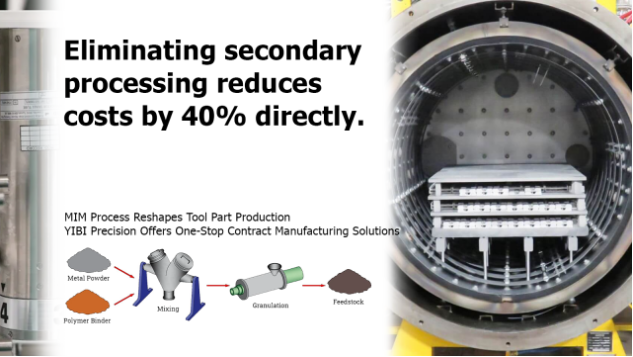
Integrating the material advantages of powder metallurgy with the shaping capabilities of injection molding, MIM realizes near-net shaping of complex precision tool components through four core processes—feedstock preparation, injection molding, debinding and sintering, and finished product inspection. It inherently avoids the need for numerous secondary operations in traditional processing, with key advantages in three dimensions:
1. Micron-level Precision, No Additional Calibration or Polishing
Precision tool components (e.g., tool shanks, micro drill accessories, wrench inner hole structures) often require micron-level tolerances. Traditional forging can only achieve a tolerance of ±0.5mm, requiring multiple milling and grinding calibrations. In contrast, MIM stably achieves tolerance control of ±0.03mm, and can lock precision within ±0.01mm for small features below 3mm.
Meanwhile, components after debinding and sintering reach a density of over 97% and a surface roughness of Ra≤0.8μm, fully meeting the assembly and operational needs of most tool components. No additional polishing or deburring is required for regular precision scenarios—only minimal machining refinement is needed for high-tolerance precision applications.
2. Integrated Molding of Complex Structures, Eliminating Process Splitting and Assembly
A large number of special-shaped components in the tool industry (e.g., tool assemblies with internal cavities, cross holes, or precision threads) require splitting into multiple machining processes and subsequent assembly using traditional techniques. This not only involves cumbersome, time-consuming processes but also easily leads to assembly gaps.
MIM can achieve one-time injection molding of these complex structures through precision molds. Whether it’s WC-Co cemented carbide wear-resistant components or 316L stainless steel corrosion-resistant parts, MIM unifies structural integrity and performance stability, directly replacing the “multi-process splitting + assembly” flow of traditional machining.
3. Maximized Material Utilization, Reduced Costs
Traditional machining typically achieves only about 60% metal material utilization, with significant waste of leftover materials driving up raw material costs. MIM, however, uses precise feedstock and mold forming to achieve a material utilization rate of over 95%. This cost control advantage is particularly notable for high-value alloy materials commonly used in the tool industry.
Additionally, MIM’s mass production efficiency is over 40% higher than traditional processes, and unit component costs can be reduced by 35%-40% in bulk production. It perfectly adapts to the large-scale production needs of the tool industry, replacing the extensive production mode of traditional machining.
Yibi Precision: A New Choice for Efficient Production
For global high-end tool manufacturers, the value realization of MIM technology depends not only on the technology itself but also on the mold design capabilities, process parameter optimization, and full-process service capabilities of contract manufacturers.
With years of experience in MIM contract manufacturing, Yibi Precision focuses on the personalized needs of the tool industry and has built an end-to-end service system from design optimization to bulk delivery, becoming a long-term partner for many European and American tool enterprises.
Our core competitiveness lies in transforming “process advantages” into “customer-perceivable value,” reflected in three key capabilities:
• Full Material Adaptability: Covering core materials in the tool industry, including WC-Co cemented carbide with hardness ≥HRA85 (for wear-resistant cutting tools), corrosion-resistant 316L stainless steel (for outdoor tools), and high-strength TC4 titanium alloy (for lightweight high-end tools). We can customize material formulas based on customer needs to balance component performance and cost.
• EU & US Compliance Assurance: Adopting water-soluble binders and catalytic debinding systems, fully complying with EU REACH Regulation and RoHS standards, as well as US ASTM precision component testing specifications. Customers do not need additional compliance investments, enabling seamless integration into European and American supply chains.
• Full-Process Quality Closed Loop: Establishing a complete system from feedstock purity testing and real-time molding process monitoring to comprehensive post-sintering testing (density, strength, precision). Equipped with professional equipment such as laser diameter gauges, hardness testers, and density detectors, the qualified rate of finished products remains stable above 99%, providing customers with traceable quality reports.
Process Complementarity, Full-Scenario Coverage
MIM focuses on efficiency and cost optimization for complex structures, mass production, and medium-to-high precision scenarios, forming a core complement to machining—machining is more suitable for ultra-large components, high-precision refinement, and small-batch customization. The combination of the two fully covers all production needs of tool components, leveraging MIM’s advantages in scale and low cost while relying on machining to compensate for the process limitations of extreme scenarios.
Whether you need to mass-produce complex special-shaped tool components, or optimize existing production processes to reduce overall costs, Yibi Precision can provide actionable contract manufacturing solutions leveraging the core advantages of MIM technology.
Feel free to send a private message to explore new possibilities for efficient production.