

In precision metal component manufacturing, CNC machining is the most familiar process for many customers.
CNC offers clear advantages: high precision, strong flexibility, suitability for prototyping and low-volume production, and compatibility with metal parts of relatively straightforward structures.
However, when parts become increasingly small, complex, and require mass production, CNC is not always the optimal solution. In such cases, MIM, or Metal Injection Molding, may emerge as a more appropriate manufacturing method.
- MIM Excels with Complex Part Geometries

CNC produces the final shape by cutting away material. This means that the more complex the part structure, the longer the machining path, the more setups required, the higher the tool wear, and the longer the processing time.
For small metal parts that simultaneously feature:
- Complex curved surfaces
- Multiple holes
- Thin-walled structures
- Recessed features
- Irregular geometries
- High consistency requirements
CNC machining becomes inefficient and costs rise significantly.
MIM operates on a different principle. Rather than “cutting” the shape from a solid block of metal, it mixes metal powder with a binder to form a feedstock, which is then molded in a manner similar to plastic injection molding, followed by debinding and sintering to produce high-density metal parts.
As such, MIM can often achieve near-net-shape forming for complex geometries. This is one of the core values of MIM: complex geometries do not significantly increase the processing time per unit, unlike CNC.
- MIM Is Ideal for Mass Production of Small Parts
CNC is highly suitable for prototyping and low-volume production. However, for small complex parts requiring production runs of tens of thousands, hundreds of thousands, or even higher quantities, the per-unit machining time of CNC becomes a significant bottleneck.
MIM requires upfront tooling investment, so it may not be suitable for very small orders. Once stable mass production begins, however, MIM’s advantages become apparent:
- Higher per-unit production efficiency
- Easier control of batch consistency
- Better material utilization
- Stable replication of complex structures
- Ideal for long-term repetitive production
Therefore, determining whether a part is suitable for MIM depends not only on its manufacturability but also on whether there is stable mass production demand in the future.
If only dozens of samples are needed, CNC is generally more cost-effective. For small complex metal parts with ongoing mass production requirements, MIM deserves serious evaluation.
- MIM May Be More Economical When Material Waste Is Significant
CNC is a subtractive manufacturing process. It removes excess material from bars, sheets, or blocks to leave the desired shape. If the part has a complex structure or the final part volume accounts for only a small fraction of the raw material, material waste will be considerable. In projects with high material costs, this waste directly impacts overall costs.
MIM uses metal powder for forming, typically offering higher material utilization and making it more suitable for producing small complex parts.
This does not imply that MIM is inherently cheaper than CNC. The true criterion is a comprehensive calculation of part complexity, order quantity, material cost, upfront tooling investment, post-processing requirements, and quality stability. Judging solely based on per-unit quotes can lead to misjudgment. When considering the total lifecycle cost, MIM is more advantageous in many mass production projects for complex small parts.
- MIM Is Preferable When Stable Consistency Is Required
In many industrial applications, parts do not function in isolation. They may be small components in smart locks, power tools, robots, medical devices, consumer electronics, or automotive systems. The requirement for such parts is typically not “producing one qualified sample,” but rather: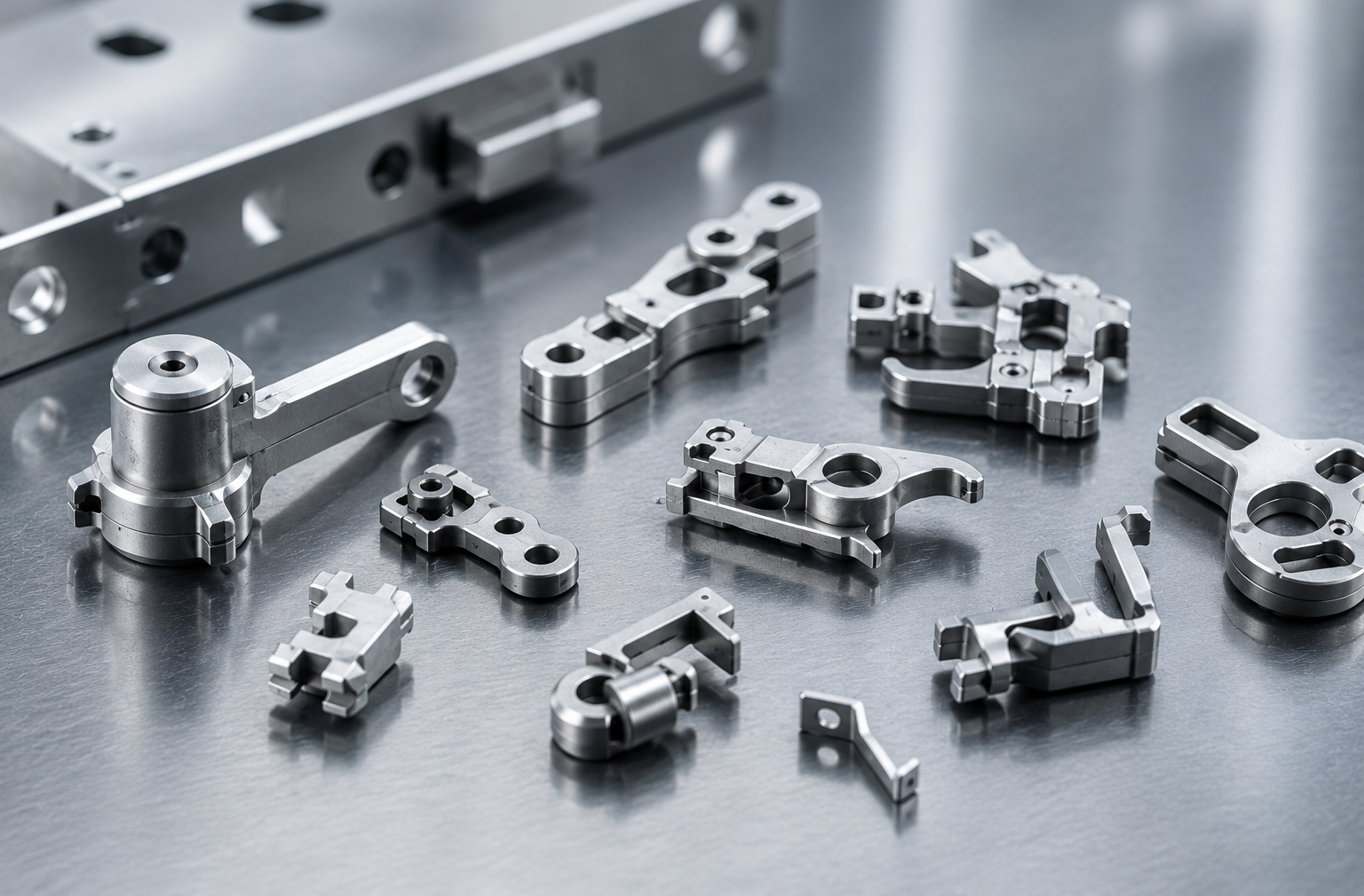
- Consistent quality across every batch
- Uniform dimensions for every unit
- Reliable performance at every assembly point
- Controllable delivery for every order
While CNC can achieve high precision, process stability control becomes more challenging as production volume increases, structures become more complex, and processes multiply.
The advantage of MIM is that once the tooling, material, sintering, and post-processing parameters are stabilized, consistent structures and properties can be continuously replicated in mass production. This is critical for OEM customers, as what they truly need is not individual parts but a long-term stable supply solution.
- When Should MIM Not Be Used?
MIM is not a universal process. CNC may be more appropriate in the following scenarios:
- The project is in the early validation phase
- Order quantities are very small
- The part has a simple structure
- The part is too large for MIM forming
- The design is not yet finalized and tooling is premature
- The customer needs a small number of samples extremely quickly
Thus, MIM and CNC are not substitutes for each other. Rather, they are suited for manufacturing needs at different stages, with different structures, and different production volumes. CNC is better for rapid validation and flexible machining, while MIM excels at the stable mass production of complex small metal parts.
- A Simple Decision Framework
When evaluating a metal part, ask the following questions:
- Is the part sufficiently small?
- Is its structure sufficiently complex?
- Does it feature holes, thin walls, curved surfaces, or irregular geometries?
- Is long-term stable mass production required?
- Is CNC machining cycle time already excessive?
- Is material waste significant?
- Will projected future order volumes justify the upfront tooling investment?
- Is dimensional consistency and batch stability of critical importance?
If the answer to multiple of these questions is “yes,” then MIM should be included in the solution evaluation.
Conclusion
CNC is a highly mature, flexible, and reliable metal processing method. However, when a project enters the combined scenario of “small size, high complexity, high consistency, and large volume,” CNC may reach its limits in terms of efficiency and cost.
The value of MIM emerges precisely at this inflection point. It is not intended to replace all CNC machining, but rather to provide a more suitable manufacturing logic for the mass production of complex small metal parts.
For OEM customers, the key is not to select a specific process at the outset, but to understand early in the product design phase how the part should be manufactured stably, economically, and scalably. This is the most noteworthy aspect of the MIM process.