
When visiting a MIM factory, the injection molding area often makes the strongest first impression.
Rows of machines run continuously. Molds open and close. Robots remove green parts one after another.
The more machines there are—and the faster they run—the greater the factory’s capacity appears to be.
But in MIM, injection speed is not the same as delivery capacity.
A green part leaving the mold is only the beginning.
It still needs to go through debinding and sintering, followed by any required sizing, heat treatment, machining, surface finishing and inspection before it becomes a finished metal component ready for delivery.
If downstream processes cannot keep pace, faster injection simply creates more work-in-process—not more qualified parts for the customer.
That is why evaluating the actual capacity of a MIM factory requires more than counting injection machines.
The more important question is whether the parts produced at the front end can continue through the remaining processes at a stable and repeatable rate.
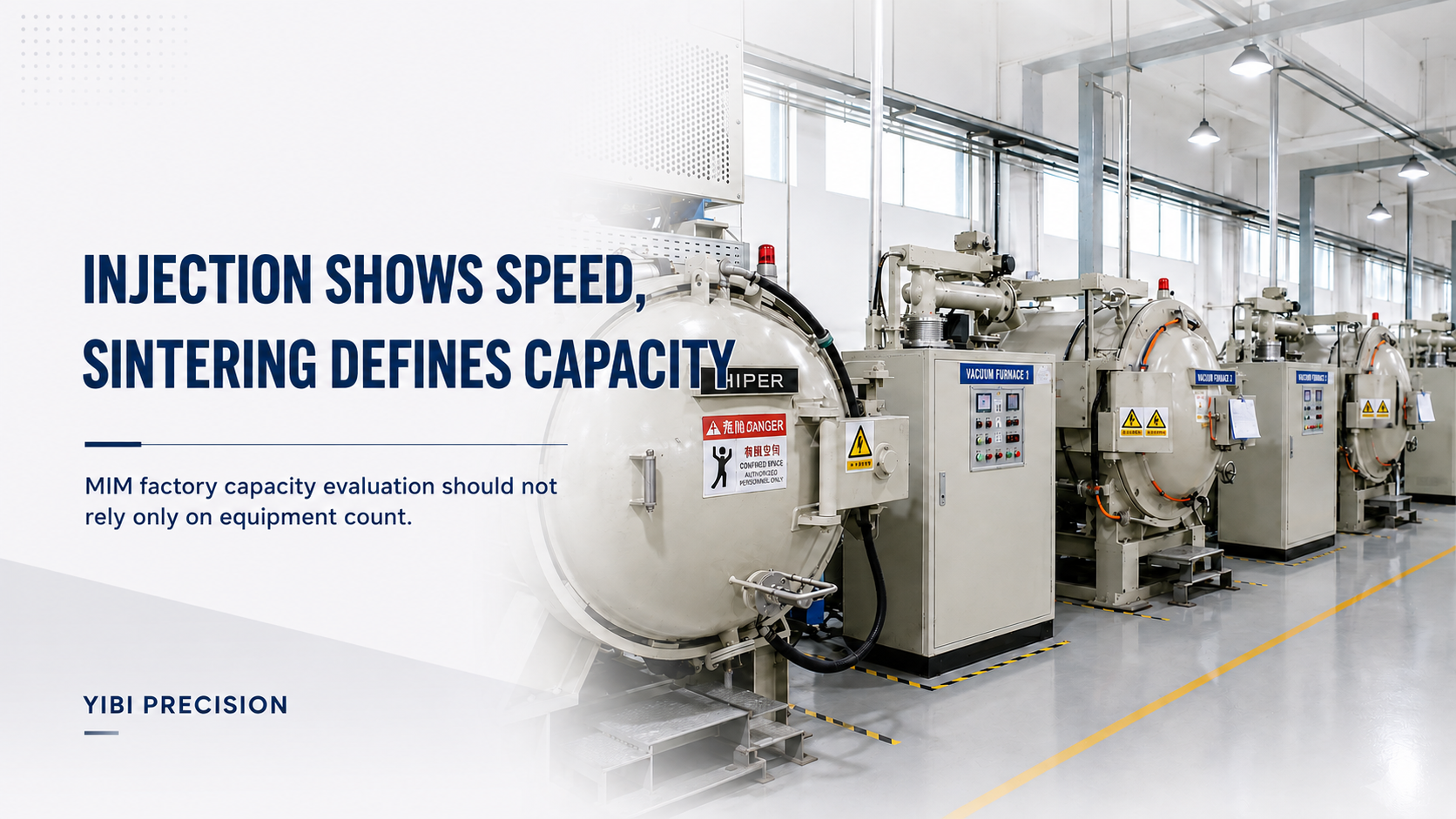
Injection Shows Speed. Sintering Reveals Capacity Limits.
Theoretical injection capacity is relatively straightforward to estimate.
The number of machines, cavity count and molding cycle time can all be used to calculate potential output.
Sintering capacity is different.
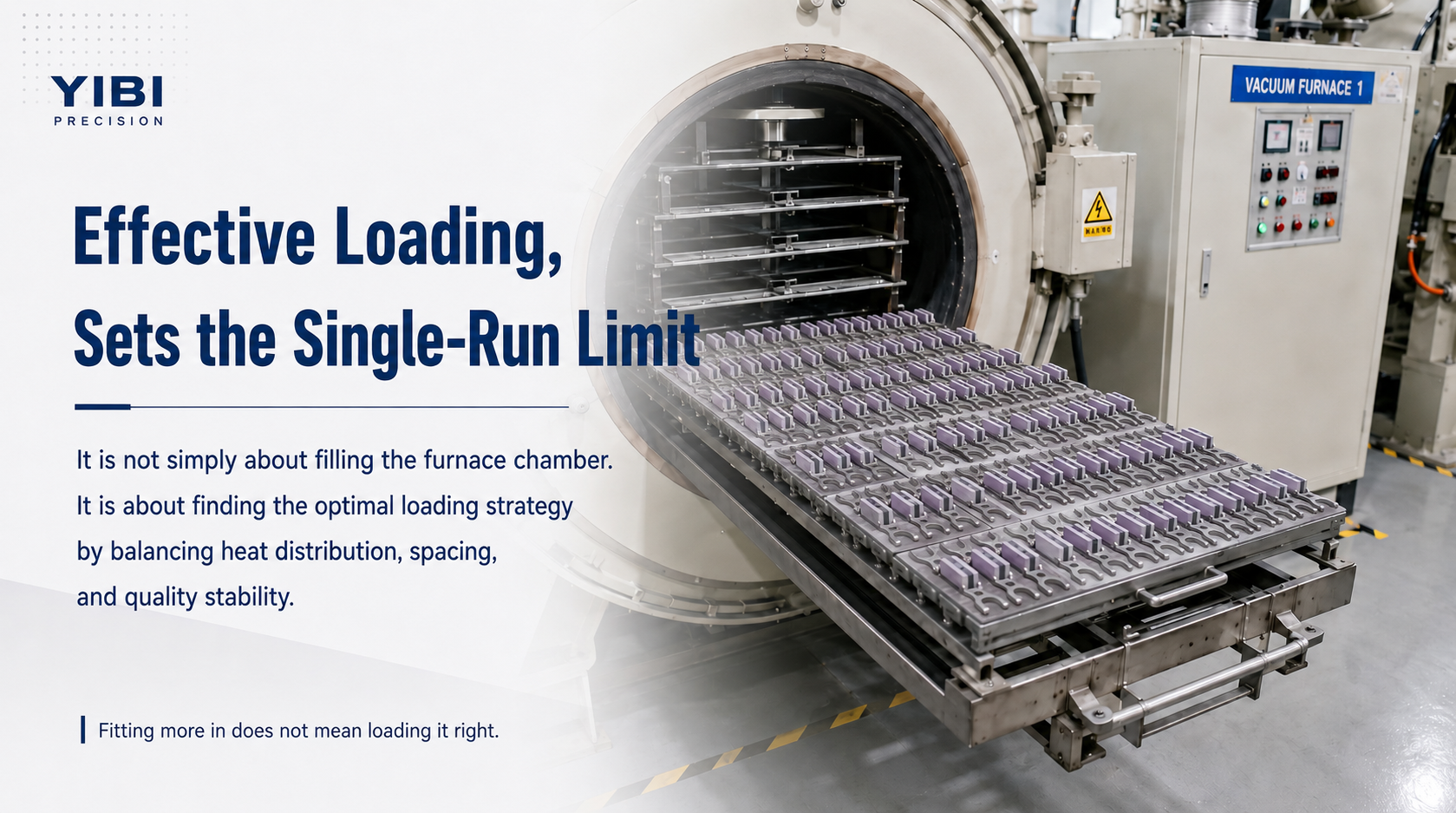
The number of parts that can be processed in a furnace run depends on more than chamber volume. Part size and geometry, loading arrangement, spacing and support requirements all affect how much of that furnace volume can actually be used.
Relatively simple parts with low distortion risk may be arranged more densely.
Components with thin walls, cantilevered features, asymmetric geometries or higher distortion risk often require greater spacing. In some cases, dedicated ceramic fixtures are also needed to control shape during sintering.
The furnace itself has not changed.
But the effective loading per run can change significantly from one product to another.
This is why furnace specifications alone cannot tell a customer how much capacity is actually available for a specific project.
A more useful question is:
Under the required loading arrangement, furnace cycle and quality requirements, how many qualified parts can this product consistently deliver per run?
The Capacity Difference Is Hidden in the Loading Strategy
Furnace loading is not simply about putting as many parts as possible into the chamber.
A repeatable loading strategy has to be developed around the characteristics of the component.
Part density, orientation, spacing and support can affect temperature uniformity, atmosphere flow and shrinkage behavior during sintering.
A loading arrangement that is too conservative reduces output.
But maximizing loading density without considering process stability can increase the risk of local distortion, dimensional variation and inconsistent performance.
The objective is therefore not maximum loading.
It is the right balance between space utilization and process stability.
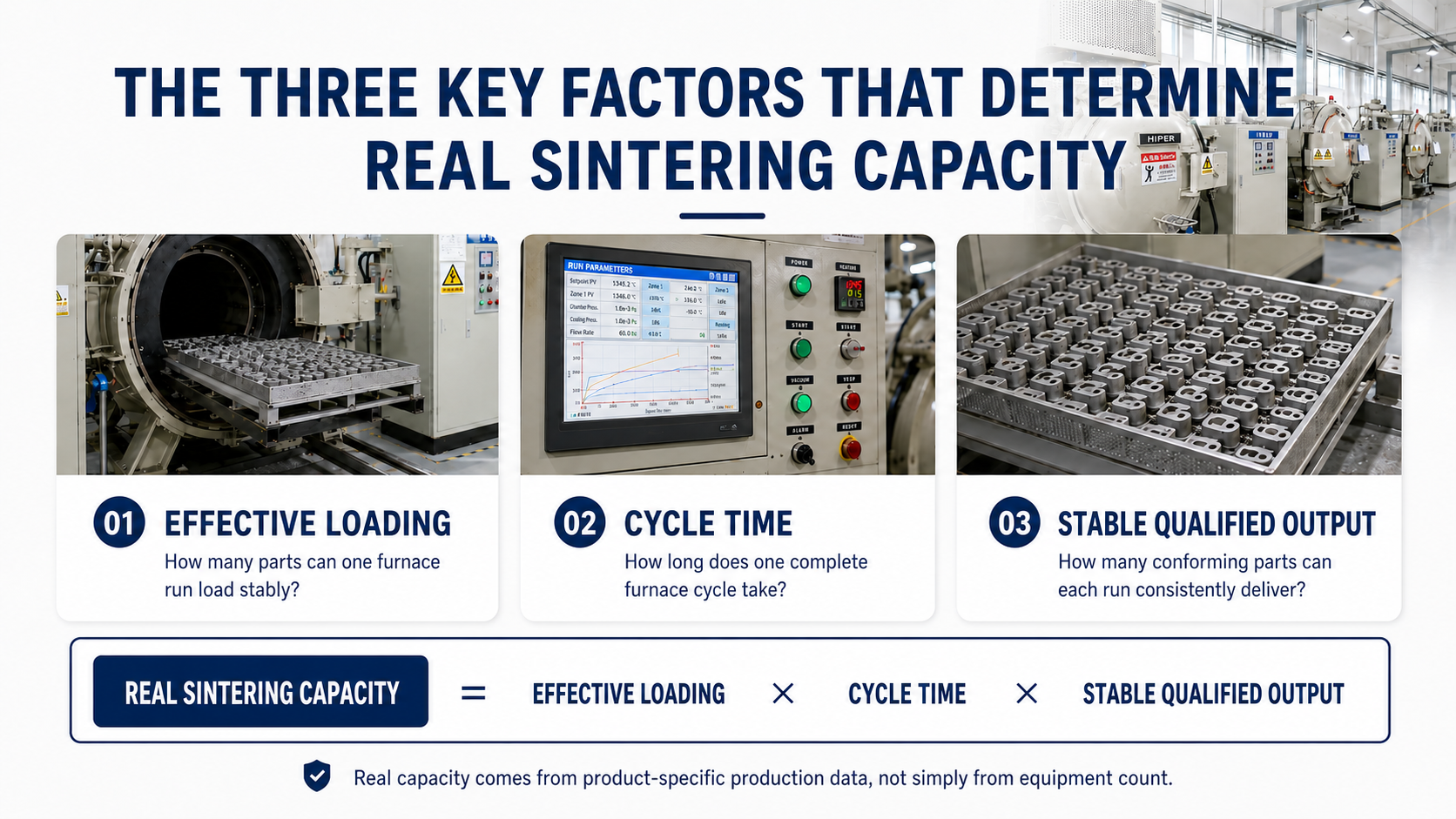
For a specific MIM project, three factors need to be understood:
- Effective Loading
How many parts can be reliably loaded in one furnace run? - Cycle Time
How long does one complete furnace cycle take? - Qualified Output per Run
How many conforming parts can each run consistently deliver?
Together, these factors determine the practical sintering capacity for a specific product.
Capacity is therefore not a fixed number taken from an equipment list.
It has to be evaluated against the component geometry, loading strategy, process cycle and actual quality results.
Only Repeatable Output Belongs in a Delivery Plan
The number of parts completed in a single furnace run is only the starting point.
That output becomes meaningful capacity only when the loading method, furnace cycle, fixture condition and quality results can be reproduced consistently across subsequent runs.
Only then can that output be built into a weekly or monthly delivery plan.
A high output from a single run is not, by itself, a reliable capacity commitment.
When demand increases, a robust capacity assessment also needs to determine whether additional furnace runs are sufficient—or whether fixtures, sizing, heat treatment, machining and inspection resources need to expand at the same time.
Real capacity is not the number shown on an equipment list.
It is the repeatable volume of qualified parts demonstrated by product-specific production data and translated into a reliable delivery plan.