
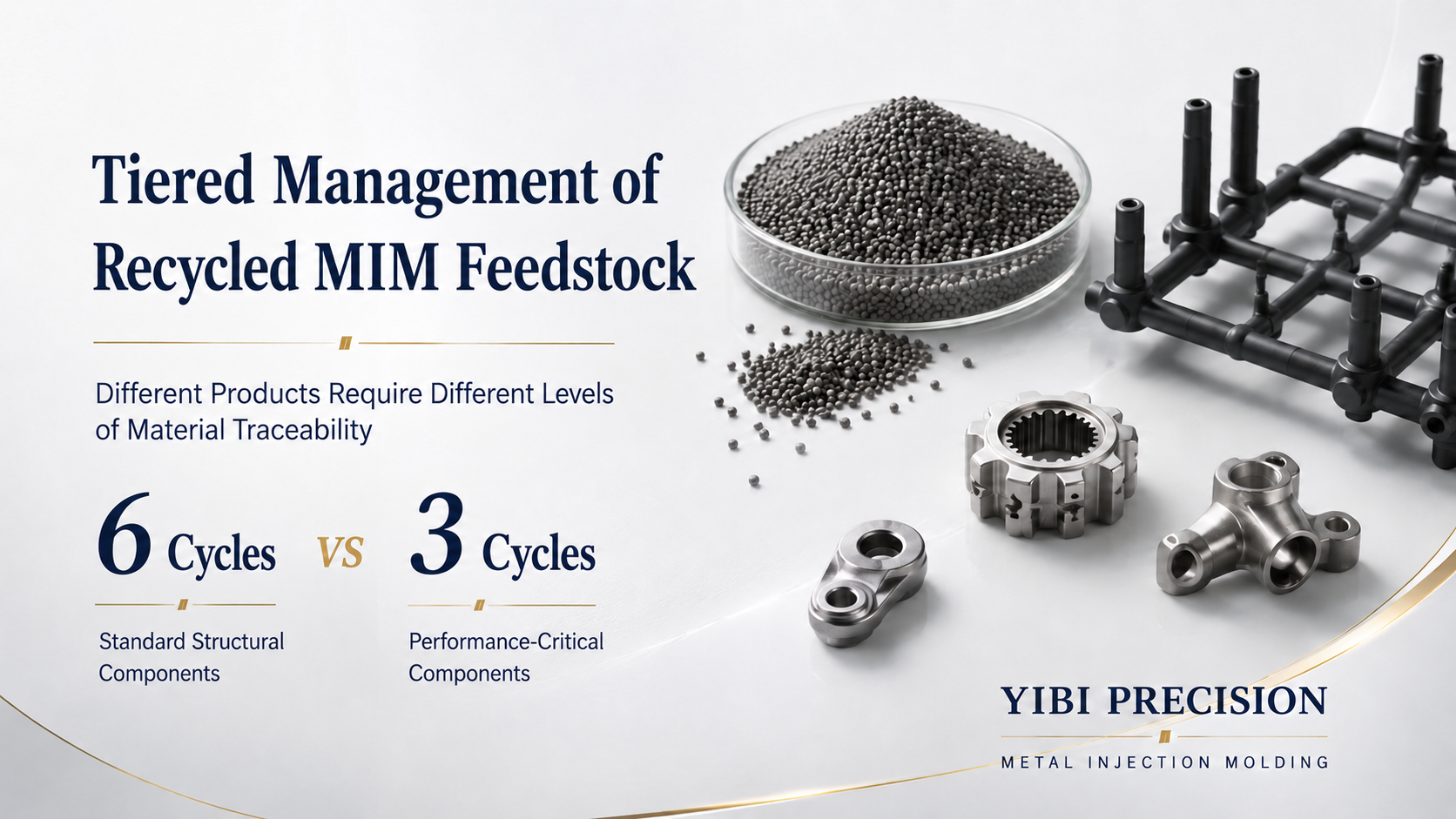
In MIM production, runners, sprues, and other feedstock generated after injection molding can be reprocessed and returned to production under controlled conditions, provided they have not yet gone through debinding or sintering.
Reusing material, however, does not mean its processing history can accumulate indefinitely.
For customers, what matters more is whether a supplier knows how many processing cycles a batch of feedstock has experienced, what condition it is currently in, and which types of components it is still suitable for.
Reuse Count Is Part of Feedstock History
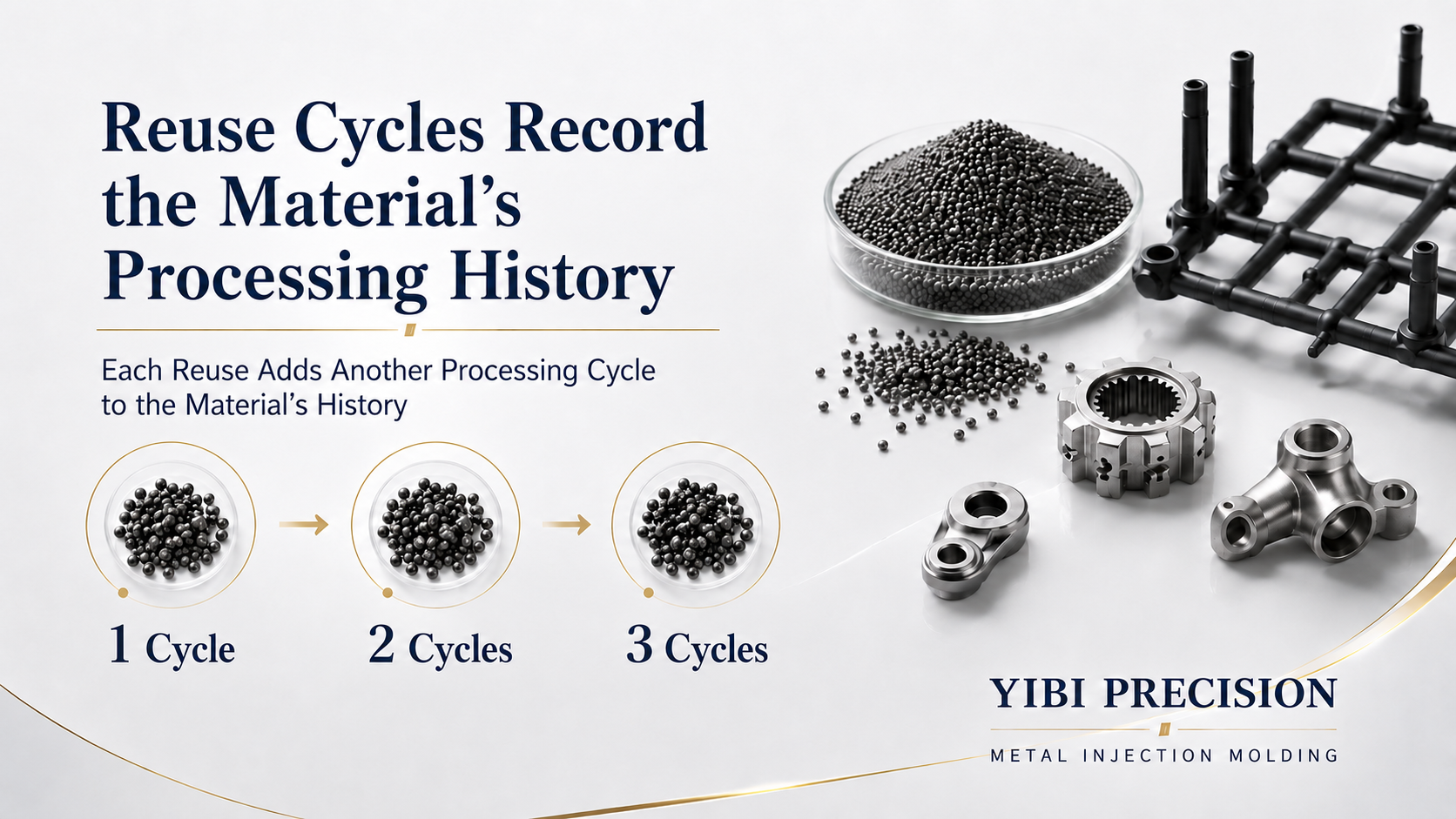
MIM feedstock consists of metal powder and a binder system. Before runners, sprues, and similar material are reused, they undergo the necessary reprocessing, such as re-compounding, before returning to production.
Each reuse adds another processing cycle to the feedstock history.
As that history accumulates, the condition of the feedstock may change. As long as those changes remain within validated and consistently controlled limits, reuse itself is not the issue.
The risk arises when reuse count and application limits are not clearly managed. At that point, feedstock condition becomes an additional variable that is difficult to evaluate in volume production.
Without Clear Reuse Limits, Material-Related Variables Increase in Production
Reprocessed feedstock can be used under controlled conditions.
The challenge begins when processing history, application limits, and suitable product categories are not clearly managed.
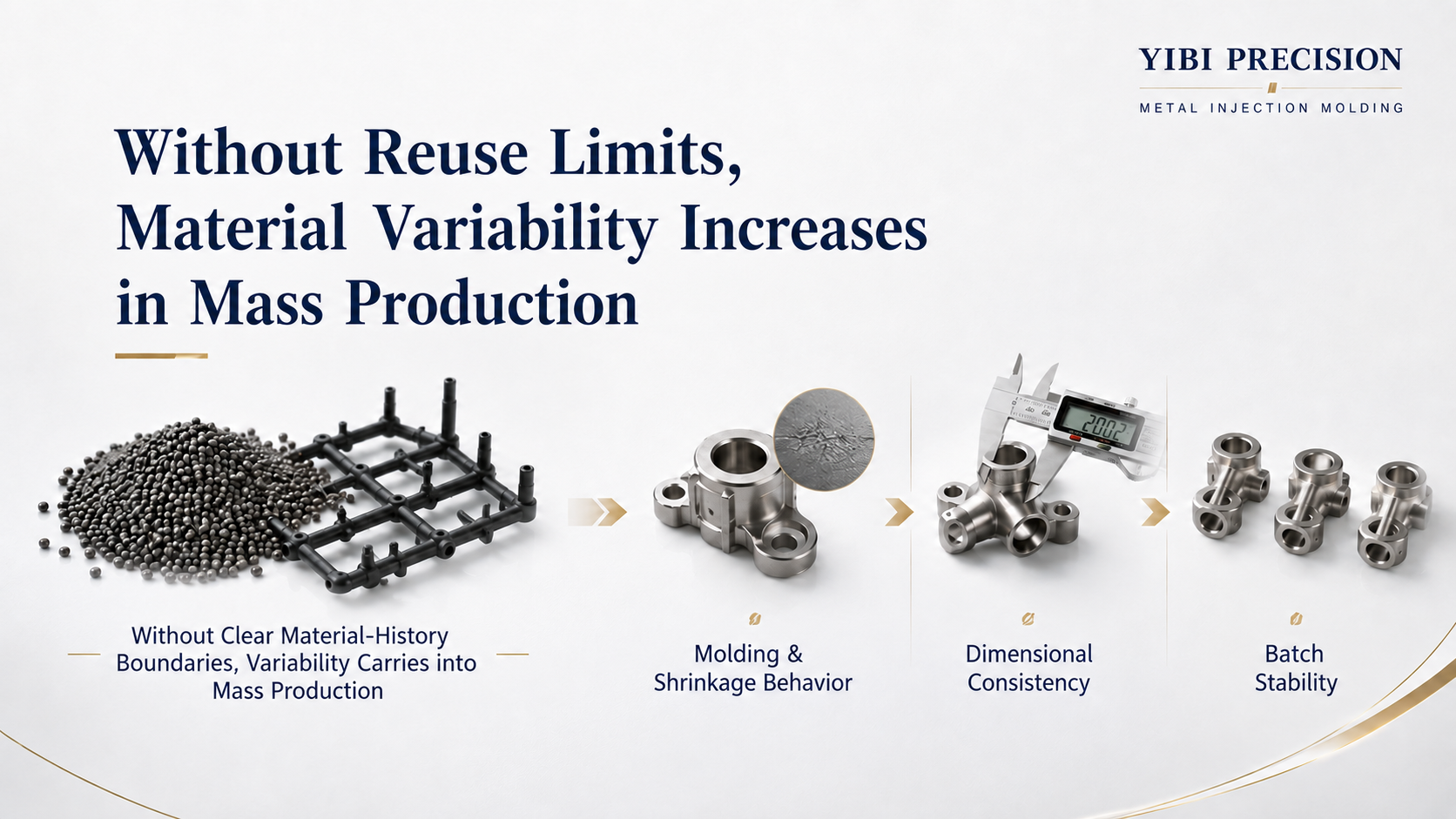
If a manufacturer cannot confirm how many processing cycles a batch of feedstock has experienced, it becomes more difficult to determine whether that material is still suitable for a particular component.
Changes in feedstock condition may also make molding behavior, shrinkage behavior, dimensional consistency, and batch-to-batch stability more difficult to control.
In continuous volume production, poorly defined material variables can also increase the burden on validation, process adjustment, and quality control.
The purpose of feedstock reuse management is therefore to keep material history identifiable and its application limits clearly defined.
Six Reuse Cycles vs. Three: Translating Product Risk into Feedstock Limits
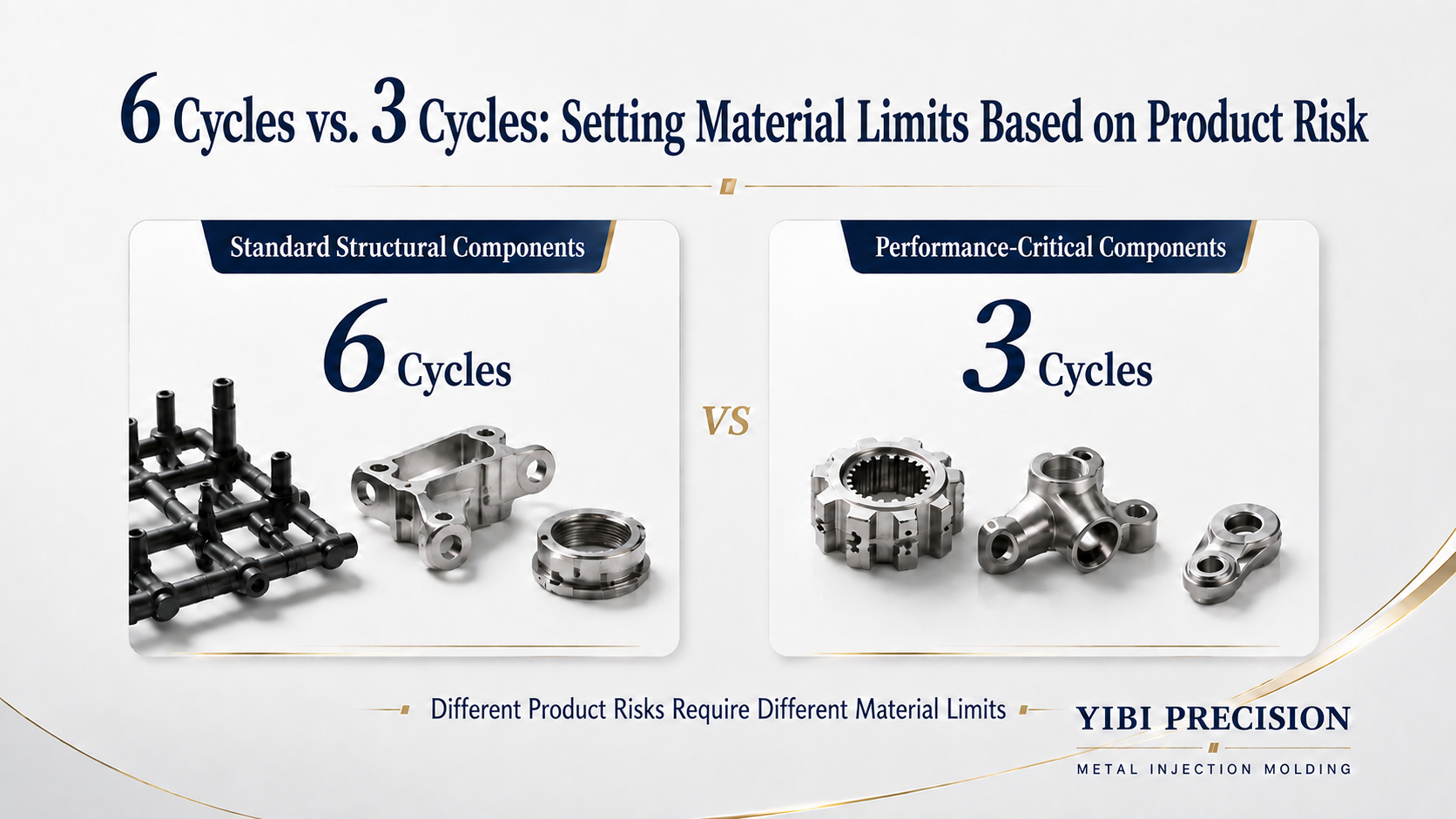
At Yibi Precision, general structural components and performance-critical components are managed with different feedstock reuse limits.
For general structural components, feedstock may be reused for up to six cycles. For performance-critical components, the limit is three.
These limits reflect product risk classification.
For general structural components, a broader reuse range can be maintained when feedstock condition and process control remain within requirements.
Performance-critical components, however, may have tighter requirements for dimensions, mechanical properties, or functional stability. Their tolerance for variation in feedstock condition is therefore lower, so a more conservative reuse limit is applied.
A batch of feedstock that remains suitable for one type of structural component does not automatically remain suitable under the same reuse limit for a performance-critical component.
When product requirements change, the acceptable application range of the feedstock needs to be reassessed as well.
Customer Requirements Define Project-Specific Feedstock Controls

When a customer has explicit requirements for material source, reuse count, or feedstock history, Yibi Precision translates those requirements into project-specific material controls.
For these projects, feedstock history, product risk, and customer specifications are evaluated together, with more conservative limits applied where necessary.
In this way, material requirements defined in customer specifications are translated into actual controls during production.
Tiered Feedstock Management Ultimately Supports Stable Production
From up to six reuse cycles for general structural components, to three for performance-critical components, and then to project-specific controls for customers with special requirements, the underlying logic is consistent:
Feedstock history must match product risk.
Effective feedstock reuse management is not simply about whether material can be reused.
It is about whether reuse limits can be clearly defined, consistently applied, and continuously managed.
Knowing what a batch of feedstock has been through, understanding which products it remains suitable for, and adjusting its application limits according to product requirements all help prevent unmanaged material variables from entering volume production.
This is one of the ways Yibi Precision uses material management to improve process control and support stable volume production.