
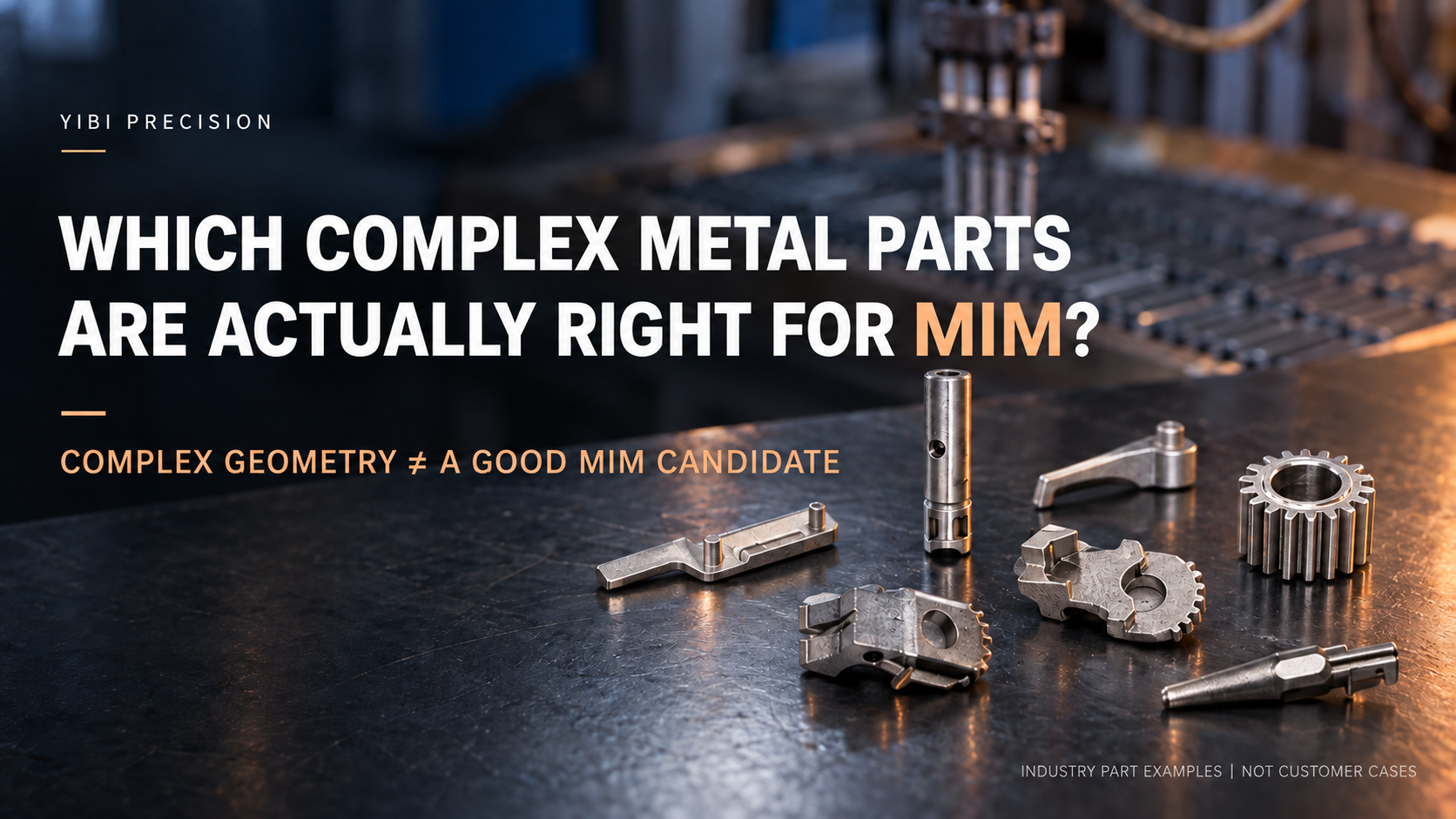
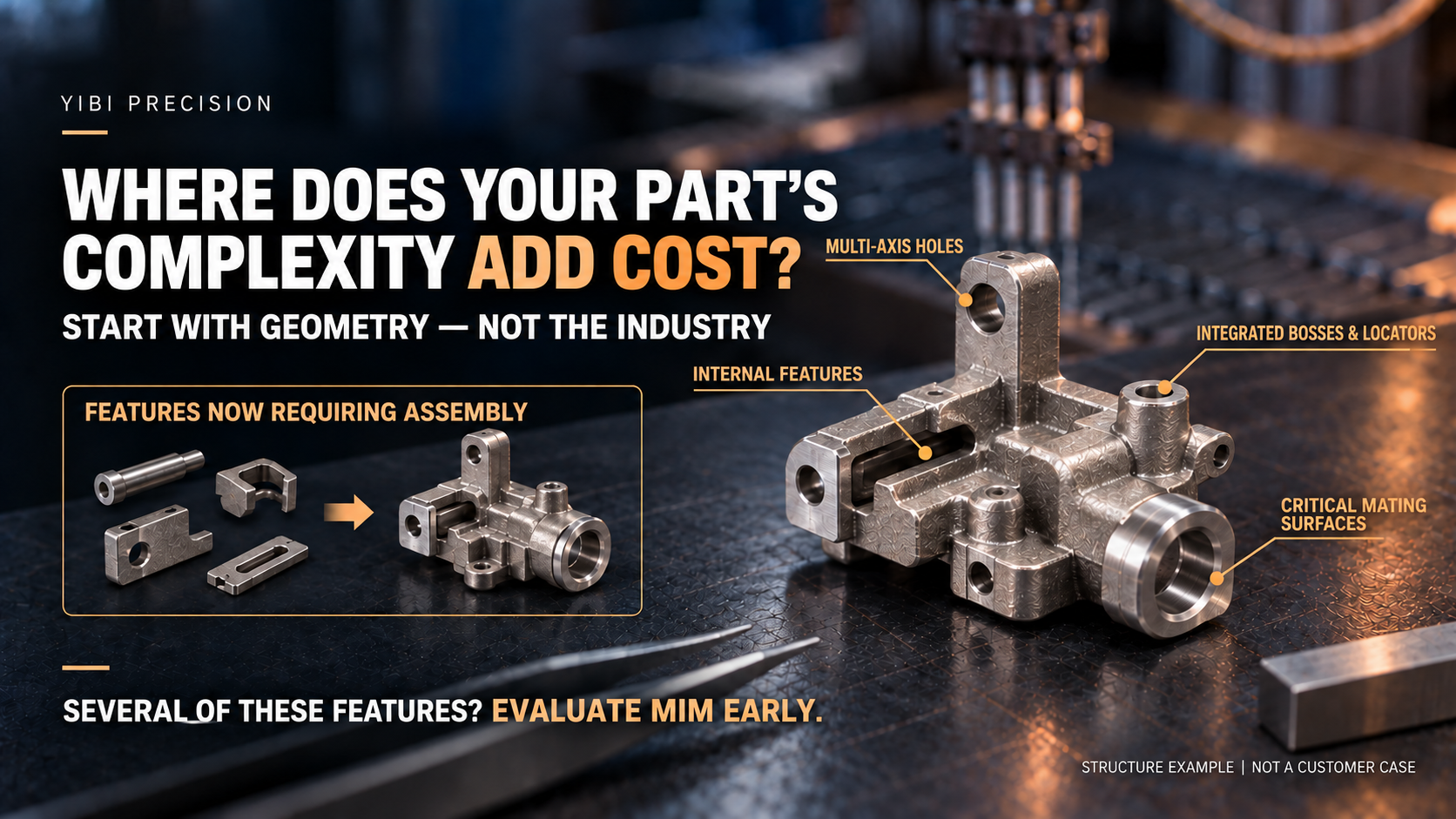
A part may appear as a single item on a drawing. On the shop floor, however, it can require multiple setups, machining from several directions, or even splitting the design into separate components that must be manufactured and assembled later.
That is the kind of complexity worth evaluating for metal injection molding (MIM).
The issue is rarely whether the part can be machined. The real question is how much production burden is added by every hole, step, slot, internal feature, and additional assembly interface.
So the first question is not simply:
Can this geometry be manufactured?
It is:
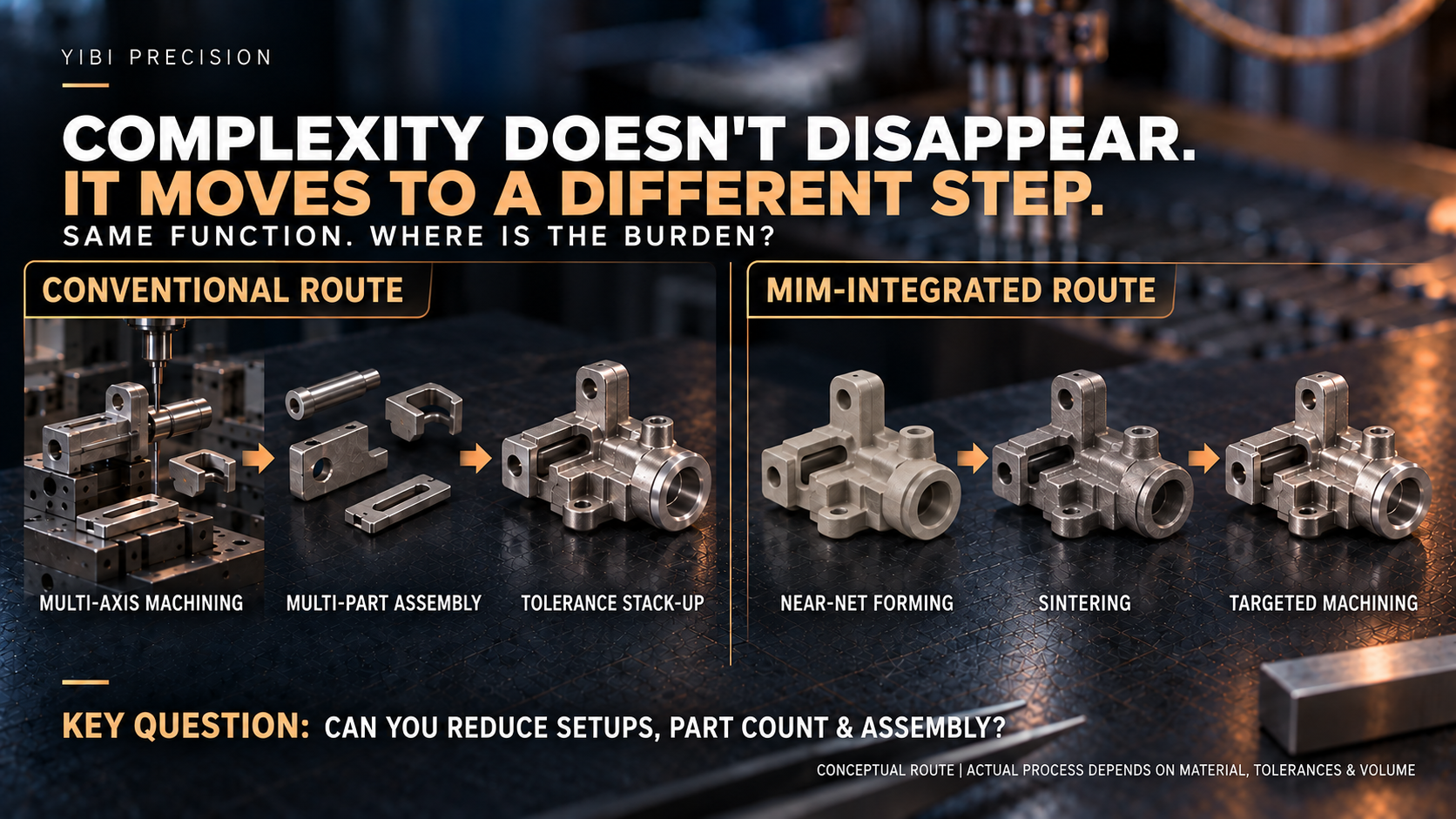
Can MIM move some of that complexity out of repeated machining and assembly operations and into the forming stage?
This is why Yibi Precision prefers to become involved early in a project.
We evaluate more than whether the part can be molded. We also look at:
Which features can be consolidated?
Which interfaces still require secondary machining?
How should the material and heat treatment match the application?
Does the expected production volume justify the tooling and process-development investment?
Across consumer electronics, EV and automotive systems, locks and security hardware, and wearable devices, the following component types often merit a closer MIM evaluation.
Consumer Electronics: Foldable-Device Hinge Brackets and Camera-Module Components
These components may be small, but they often need to provide connection, location, and load-bearing functions within a very limited envelope.
Multi-axis holes, bosses, steps, and irregular profiles can quickly multiply CNC setups and tool-access requirements. If the geometry cannot be produced as one piece, the design may also need separate parts and additional assembly operations.
At Yibi Precision, we first assess which features can be formed together, whether functions currently spread across several components can be consolidated, and which pivot bores or mating surfaces should retain machining allowance.
Tool design, sintering shrinkage, localized machining, and inspection are then planned as one manufacturing route.
The goal is not to eliminate CNC machining at any cost. It is to move from machining the entire component to forming the main geometry and machining only the interfaces that truly require it.
EV and Automotive: Sensor Housings and Small Actuator Components
For sensor housings, compact actuators, locking mechanisms, and precision transmission components, geometry is only part of the requirement.
These parts may also need strength, wear and corrosion resistance, temperature stability, and repeatable performance at production volume. Designs are sometimes simplified for cutting-tool access or divided into multiple pieces that must later be fastened, welded, or assembled.
For these projects, Yibi Precision evaluates geometry, material, and production requirements together.
Which ribs, holes, and connection features can be molded? Which areas require heat treatment or secondary machining? Which dimensions directly affect assembly or function? These decisions should be made before tooling begins.
Here, the value of MIM is not the removal of one machining operation. It is the ability to reproduce a complex geometry through a controlled tooling and process route while reducing tolerance variation and potential failure points created by multi-part assembly.
Locks and Security Hardware: Latches, Cams, and Lock-Core Transmission Components
Lock mechanisms often need to integrate teeth, cam surfaces, holes, connection features, and load-bearing areas into a very small space.
When those functions are distributed across separately machined parts, the process grows longer and individual dimensional variations can accumulate during assembly, affecting fit and motion.
Yibi Precision evaluates which transmission and connection features can be consolidated, then defines material, heat-treatment, and critical-dimension controls around wear resistance, strength, and service life.
If several functions can be combined into one MIM component, the benefit extends beyond reducing machining operations.
Part count, assembly interfaces, tolerance stack-up, and potential failure points can all be reduced.
Wearables: Clasps, Buttons, and Micro Hinges
Wearable-device components are both functional hardware and visible, touchable product surfaces.
Clasps, buttons, and micro hinges must meet dimensional requirements while also delivering controlled edges, consistent actuation, wear resistance, and a uniform finish.
For these projects, Yibi Precision evaluates forming and finishing as a connected process.
Which internal connection features can be produced through MIM? Which cosmetic surfaces still require machining, polishing, or coating? Can the structure be simplified without sacrificing assembly accuracy or tactile performance?
Producing the shape is not enough. Tooling, sintering, secondary machining, and surface finishing must all support the final product requirement.
Complexity alone does not make a part a good MIM candidate.
If volume is low, the design is still changing frequently, or most critical dimensions still require extensive machining, the tooling and development investment may not be justified.
Yibi Precision’s role is not to convert every CNC-machined part to MIM.
It is to help determine:
Which features should be molded, which interfaces must be machined, which functions can be consolidated, and whether MIM creates a better manufacturing route for the complete part.
If you are evaluating a complex metal component, share the part envelope, material requirements, estimated annual volume, critical tolerances, functional surfaces, and finishing requirements with Yibi Precision.
The final question is not only:
Can this part be made with MIM?
It is:
Can MIM create a manufacturing route with less machining, fewer assembly operations, and better repeatability at production scale?
#MetalInjectionMolding #MIM #DesignForManufacturing #AutomotiveManufacturing #ConsumerElectronics