
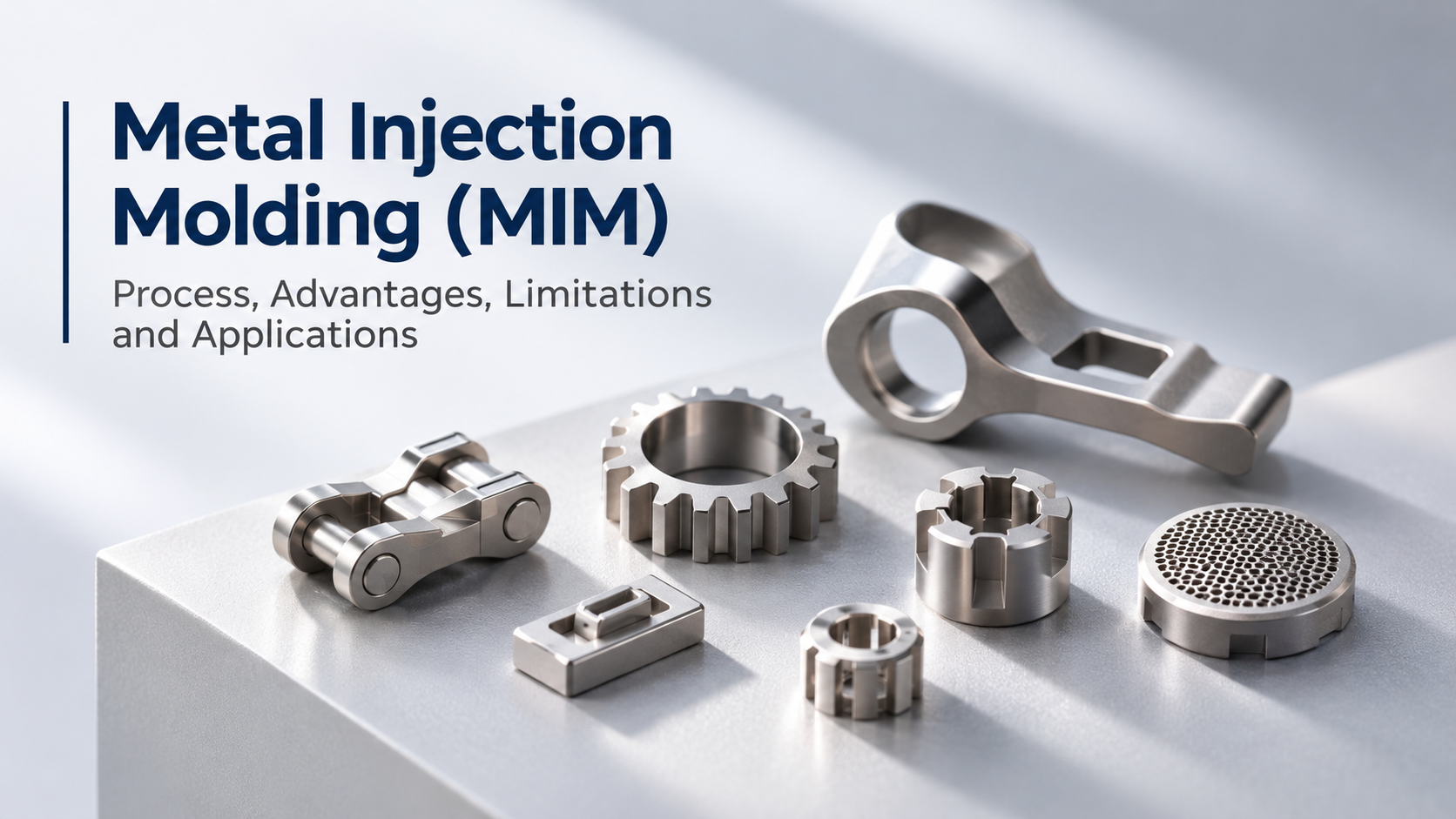
Metal Injection Molding (MIM) has become an established manufacturing process for producing small, complex metal components at scale.
By combining the design flexibility of injection molding with the material properties achievable through powder metallurgy, MIM enables manufacturers to produce intricate geometries that may be difficult or costly to achieve through conventional machining.
But how does the process work, what are its limitations, and when does MIM make sense from an engineering and manufacturing perspective?
This guide covers the fundamentals.
01 | What Is Metal Injection Molding (MIM)?
Metal Injection Molding (MIM) is a precision manufacturing process that combines plastic injection molding technology with powder metallurgy and sintering.
In simple terms, fine metal powder is mixed with a binder system, injection molded into the desired geometry, and then processed through debinding and high-temperature sintering to produce a dense metal component.
The process is particularly suitable for components requiring:
- Small dimensions and complex geometries
- Thin walls and intricate structural features
- Repeatable production at medium to high volumes
- Engineering materials such as stainless steel, titanium alloys, and soft magnetic alloys
MIM is used across industries including consumer electronics, medical devices, automotive systems, and industrial automation.
Its primary advantage lies in combining complex part geometry with scalable, repeatable manufacturing.
02 | How Does MIM Work?
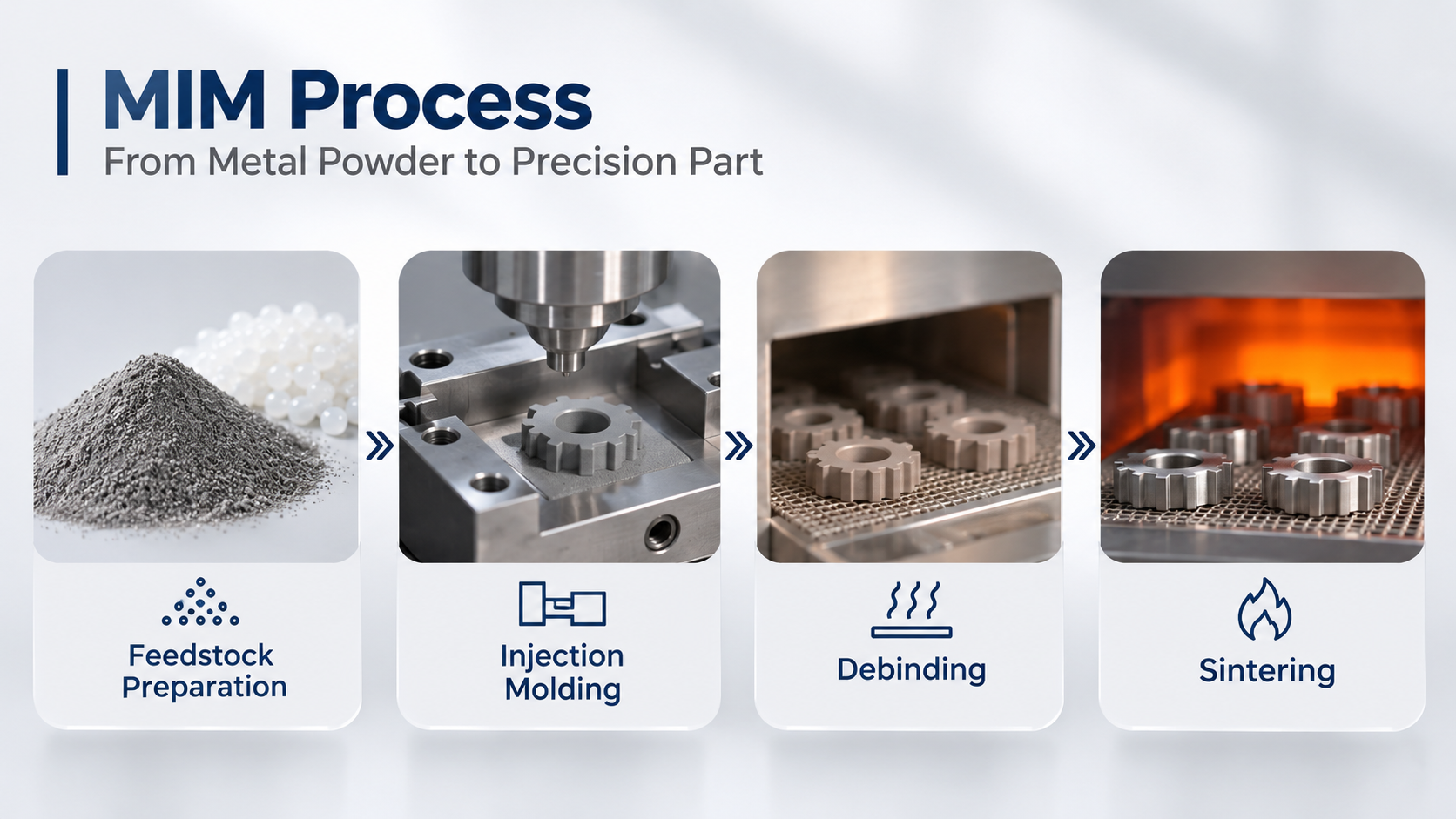
The fundamental principle of MIM can be understood through three stages:
- Feedstock preparation
Fine metal powder is combined with a carefully formulated polymer binder system to create a homogeneous, moldable feedstock.
- Injection molding
The feedstock is injected into a precision mold under controlled pressure and temperature.
Once cooled, the molded component, known as a green part, retains the intended geometry but still contains the binder.
- Debinding and sintering
The binder is progressively removed, and the remaining metal powder structure is heated under controlled conditions.
During sintering, metal particles bond together, the component shrinks, and its density and mechanical properties develop.
The result is a near-net-shape metal component that may require little additional machining, depending on its functional requirements.
03 | The Four Main Stages of MIM Production
Stage 1: Feedstock Preparation
MIM production begins with the selection of suitable metal powders and binder materials.
Common material options include:
- 316L stainless steel
- 17-4 PH stainless steel
- Titanium alloys
- Soft magnetic alloys
The metal powder and binder are mixed under controlled conditions to achieve consistent powder distribution and flow characteristics.
Why it matters:
Feedstock consistency directly affects mold filling, shrinkage behavior, dimensional stability, and production yield.
Variations at this stage can influence the entire manufacturing process.
Stage 2: Precision Injection Molding
The prepared feedstock is heated and injected into a precision-engineered mold.
After cooling, the green part is ejected with its intended geometry.
MIM can accommodate features such as thin walls, fine ribs, complex contours, and multiple functional details, provided the design is compatible with tooling and molding requirements.
Why it matters:
For suitable geometries, injection molding allows multiple features to be formed in a single operation, potentially reducing the number of machining and assembly steps.
However, tooling design and component geometry remain critical considerations.
Stage 3: Debinding
Debinding removes the binder system while preserving the structural integrity of the molded component.
Depending on the feedstock and process configuration, manufacturers may use:
- Catalytic debinding
- Solvent debinding
- Thermal debinding
Binder removal must be carefully controlled to prevent distortion, cracking, residual contamination, and internal defects.
Why it matters:
Insufficient or uneven debinding can affect porosity, dimensional stability, and final mechanical performance.
This stage requires precise control of temperature, processing conditions, and binder removal rates.
Stage 4: High-Temperature Sintering
After debinding, the component undergoes sintering in a controlled atmosphere or vacuum furnace.
During this process, metal particles bond and the component undergoes substantial, predictable shrinkage as its density increases.
The final properties depend on material composition, sintering temperature, atmosphere, and process control.
Depending on the application, additional operations may include:
- Heat treatment
- Shot blasting
- Precision machining
- Polishing
- Electroplating or PVD coating
- Passivation
Why it matters:
Sintering is central to achieving the required density, dimensional consistency, and mechanical performance.
Controlling shrinkage and distortion across production batches is one of the most important technical capabilities in MIM manufacturing.

04 | Five Key Advantages of MIM
1. Greater Design Flexibility for Complex Components
MIM allows manufacturers to produce small, geometrically complex components that may otherwise require multiple CNC machining operations.
Features such as fine ribs, thin walls, complex external contours, and integrated structural details can often be incorporated into a single molded component.
This can reduce machining requirements and simplify downstream assembly.
2. Competitive Unit Costs at Higher Production Volumes
MIM requires an initial investment in tooling and process development.
However, once production is established, the process can offer attractive unit costs for repeatable, medium- to high-volume manufacturing.
The economic advantage generally becomes more significant as production volumes increase, particularly when a component would otherwise require extensive machining.
3. Strong Material and Mechanical Performance
Properly processed MIM components can achieve high sintered densities, commonly around 95–98% of theoretical density or higher, depending on the alloy and process.
Mechanical properties can meet the requirements of many demanding industrial applications.
Final performance, including strength, hardness, ductility, and corrosion resistance, depends on the selected material, part design, and processing conditions.
4. Repeatability for Volume Manufacturing
Once tooling, feedstock, and sintering parameters are validated, MIM supports repeatable production of complex components.
Stable process control helps maintain dimensional consistency across production batches.
This is particularly valuable for components intended for automated assembly or applications requiring reliable interchangeability.
5. Efficient Material Utilization
Unlike subtractive machining, MIM forms components close to their final geometry.
This reduces the amount of metal removed during manufacturing and can improve material efficiency, especially for expensive alloys.
Although feedstock losses, tooling runners, and secondary operations must still be considered, MIM can offer meaningful material savings for suitable component designs.
05 | What Are the Limitations of MIM?
MIM offers important advantages, but it is not the ideal solution for every metal component.
Understanding its limitations is essential when selecting a manufacturing process.
1. Component Size and Weight
MIM is generally most competitive for relatively small components.
Parts weighing from fractions of a gram to approximately 100 grams are common, although the practical range varies with geometry, material, and manufacturing capability.
Larger or heavier components can introduce greater challenges in debinding, sintering distortion, and production economics.
2. Initial Tooling Costs
MIM requires dedicated tooling and process validation.
For prototypes or very low production volumes, CNC machining may offer greater flexibility and lower initial investment.
MIM becomes more attractive when production requirements justify the tooling cost.
3. Dimensional Tolerance Limitations
MIM can achieve good dimensional accuracy, but sintering shrinkage must be carefully managed.
While tolerances around ±0.05 mm may be achievable for certain features, achievable tolerances depend on part dimensions, geometry, materials, and process capability.
Components requiring exceptionally tight tolerances may need secondary precision machining.
4. Wall Thickness Considerations
Significant variations in wall thickness can create challenges during debinding and sintering.
Thick sections may increase the risk of internal porosity or non-uniform densification, while extremely thin features can be difficult to mold consistently.
Wall thicknesses in the approximate range of 0.3–3 mm may be suitable for certain MIM designs, but the appropriate range must be evaluated for each specific component.
Design optimization is therefore an important part of successful MIM development.
06 | Where Is MIM Used?
MIM is widely applied in industries where component miniaturization, geometric complexity, and manufacturing repeatability are important.
Consumer Electronics
Hinge mechanisms, smartwatch structural components, wireless earbud components, and miniature actuator parts.
Medical Devices
Minimally invasive surgical instrument components, orthodontic parts, and selected medical-grade titanium components, subject to applicable material and regulatory requirements.
Automotive and Electric Vehicles
Sensor housings, solenoid valve components, small mechanical elements, and precision metal parts used in automotive systems.
Industrial Automation and Robotics
Miniature gears, pins, transmission elements, and complex mechanical components.
Precision Hardware and Specialized Industrial Applications
Lock mechanisms, small cutting-tool components, high-density counterweights, and other precision-engineered metal parts.
Across these applications, the common requirement is the ability to manufacture intricate metal components consistently and economically at the intended production volume.
07 | When Should You Consider MIM?
MIM is worth evaluating when a component presents several of the following characteristics:
Complex Geometry
The design contains multiple intricate features, thin walls, or structures that are difficult to machine efficiently.
Medium- to High-Volume Production
The expected production volume can justify tooling investment and support competitive unit costs.
High Machining Complexity
Conventional machining requires multiple setups, extensive material removal, or long cycle times.
Specific Material Requirements
The application requires engineering materials such as stainless steel, titanium alloys, or soft magnetic alloys.
However, no single factor automatically makes MIM the best manufacturing choice.
A proper evaluation should consider part geometry, material selection, annual production volume, dimensional tolerances, mechanical requirements, and total manufacturing cost.
Final Thoughts
Metal Injection Molding offers a compelling combination of geometric flexibility, material performance, and manufacturing efficiency.
Its greatest value emerges when component design, tooling strategy, material selection, and sintering control are considered together from the early development stages.
For engineers and product development teams, the question is not simply whether MIM can produce a component.
The more important question is whether MIM can deliver the required performance, consistency, and cost efficiency at the intended production scale.
That is where manufacturing expertise makes the difference.