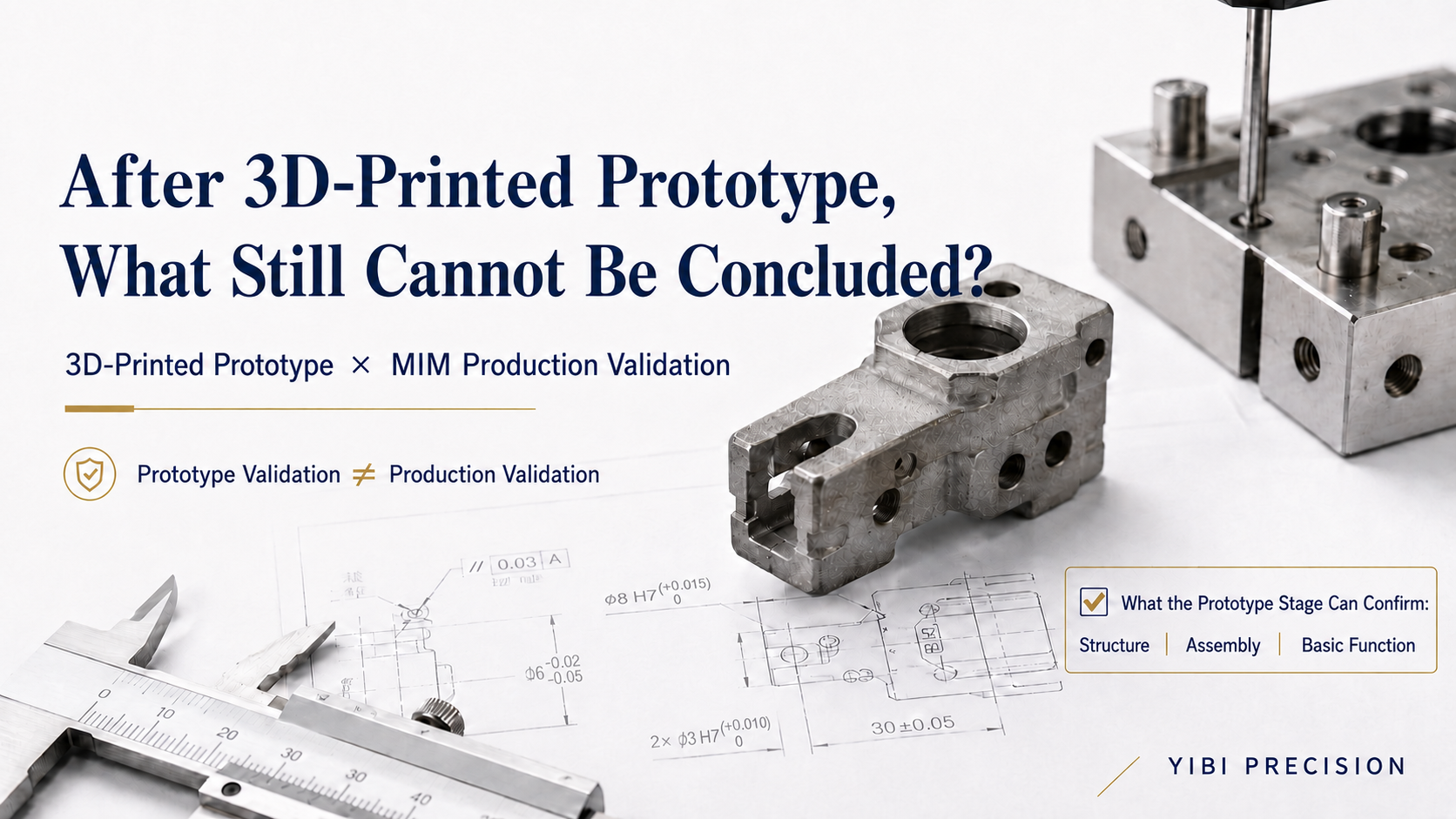
Before committing to MIM tooling, metal 3D printing can turn a digital design into a physical prototype, helping teams identify design issues earlier in the development process.
But there is an important boundary:
Prototype validation ≠ Production validation.
The real question is: how far can a 3D-printed prototype actually take the validation process?
Prototype Validation Starts with the Design
Compared with reviewing a 3D model on screen, a physical prototype allows the design to be evaluated in a real product and assembly environment.
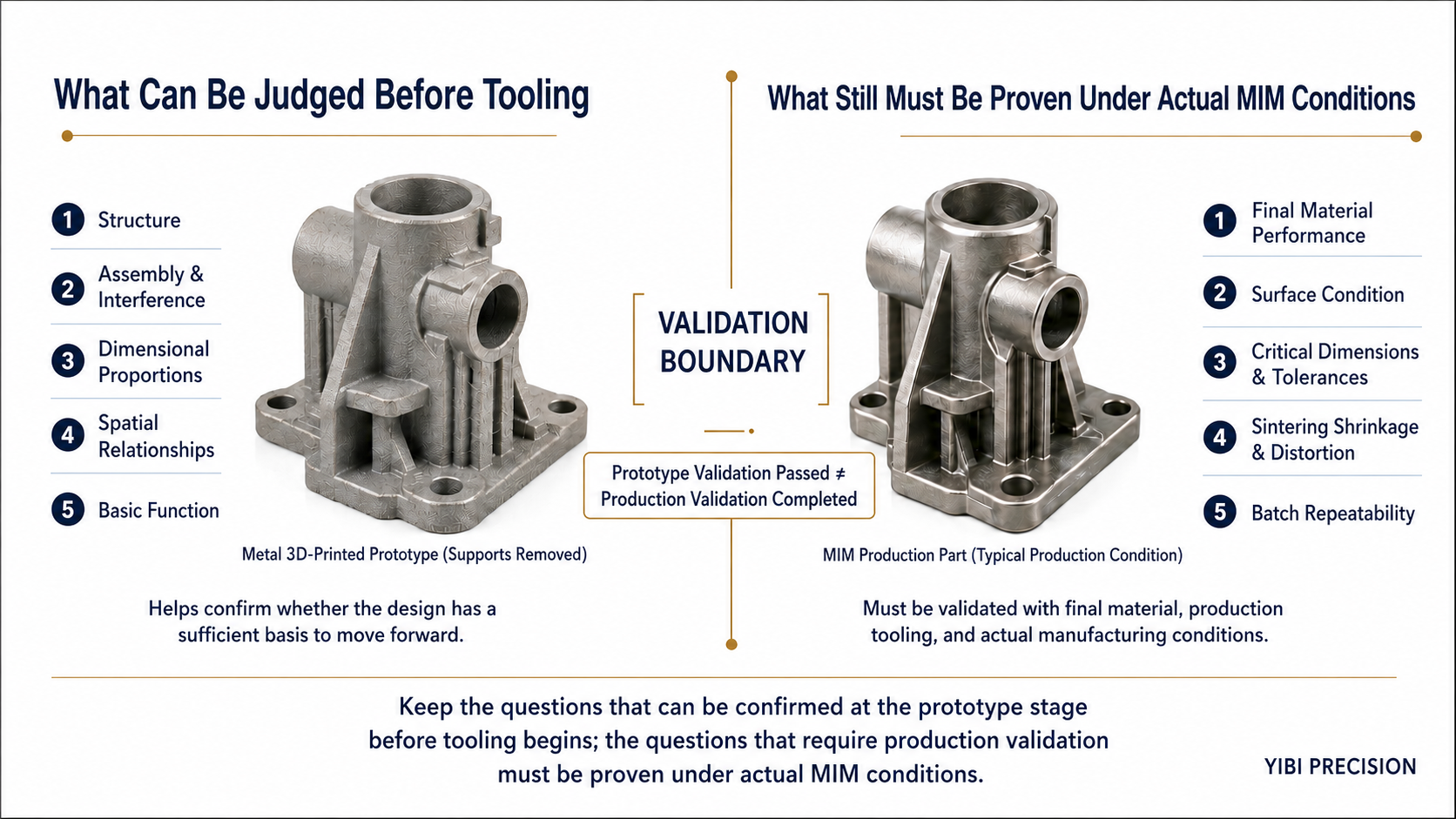
1. Structure, Assembly, and Interference
Can the part be installed in the intended position?
Does it interfere with surrounding components during assembly?
Are there obvious collisions during movement?
These issues are often easier to identify once the design exists as a physical part.
2. Proportions and Spatial Relationships
Dimensions may look reasonable in CAD, but a physical prototype makes it easier to judge whether certain features are too thick, whether enough installation space is available, and whether the relationships between components work in the actual product.
3. Basic Functional Logic
If the design involves insertion, engagement, rotation, or other simple movements, a prototype can help confirm whether the basic functional concept works as intended.
For example:
- Can the part fit into the intended interface?
- Can a latch or engagement feature operate correctly?
- Does the intended motion path reveal any obvious issues?
4. A Shared Physical Reference
A physical prototype also gives designers, engineers, and customers a common object to review.
Questions that may be difficult to resolve from drawings alone often become much clearer when everyone can evaluate the same physical sample and discuss where changes are needed.
Together, these checks help answer one question:
Before tooling begins, is the design mature enough to move forward?
What Still Needs to Be Validated in MIM Production
Passing prototype validation only confirms that the relevant design questions have been addressed at an early stage.
Once the project moves into MIM, the final material, production tooling, and manufacturing route are different. A new set of requirements must therefore be validated under actual MIM conditions.
1. Final Material Performance
Even if a 3D-printed prototype passes an initial functional or performance test, its strength, hardness, and other material properties cannot be treated as equivalent to those of the final MIM part.
The final part still needs to be validated using the actual MIM material and process conditions.
2. Final Surface Condition
Metal 3D printing and MIM use different forming and post-processing routes.
As a result, the surface condition of a prototype cannot be used as a direct reference for the final surface quality of the MIM part.
3. Critical Dimensions and Tolerance Capability
A prototype can help confirm whether dimensional relationships are reasonable and whether the part can be assembled.
But the final MIM part must still go through molding, debinding, and sintering.
Whether critical dimensions can consistently meet drawing requirements must therefore be validated under actual MIM manufacturing conditions.
4. Sintering Shrinkage and Distortion
Shrinkage and distortion during sintering are part of the MIM manufacturing process itself.
Their final effects must be controlled and validated during MIM development and cannot be inferred directly from a 3D-printed prototype.
5. Batch-to-Batch Repeatability
A successful prototype does not prove that critical dimensions, performance, and function will remain consistent when the same part is produced repeatedly in volume.
That question belongs to production validation.
This is the key boundary between Prototype Validation and Production Validation.
Resolve Design Risk Before Tooling
The value of a 3D-printed prototype is to confirm structure, assembly, spatial relationships, and basic function early enough for design changes to happen before production tooling is committed.
Once the project enters MIM development, the focus shifts to the final material, production tooling, critical dimensions, performance, sintering behavior, and batch stability.
Prototype validation addresses uncertainty in the design stage. Production validation addresses uncertainty under real manufacturing conditions.
For Yibi Precision, the goal is to let each stage address the risks it is best suited to resolve: identify design issues earlier, then complete the validation required for reliable production under actual MIM conditions.
The value of metal 3D printing is not to prove MIM production in advance. It is to resolve as many design issues as possible before the project commits to production tooling.