
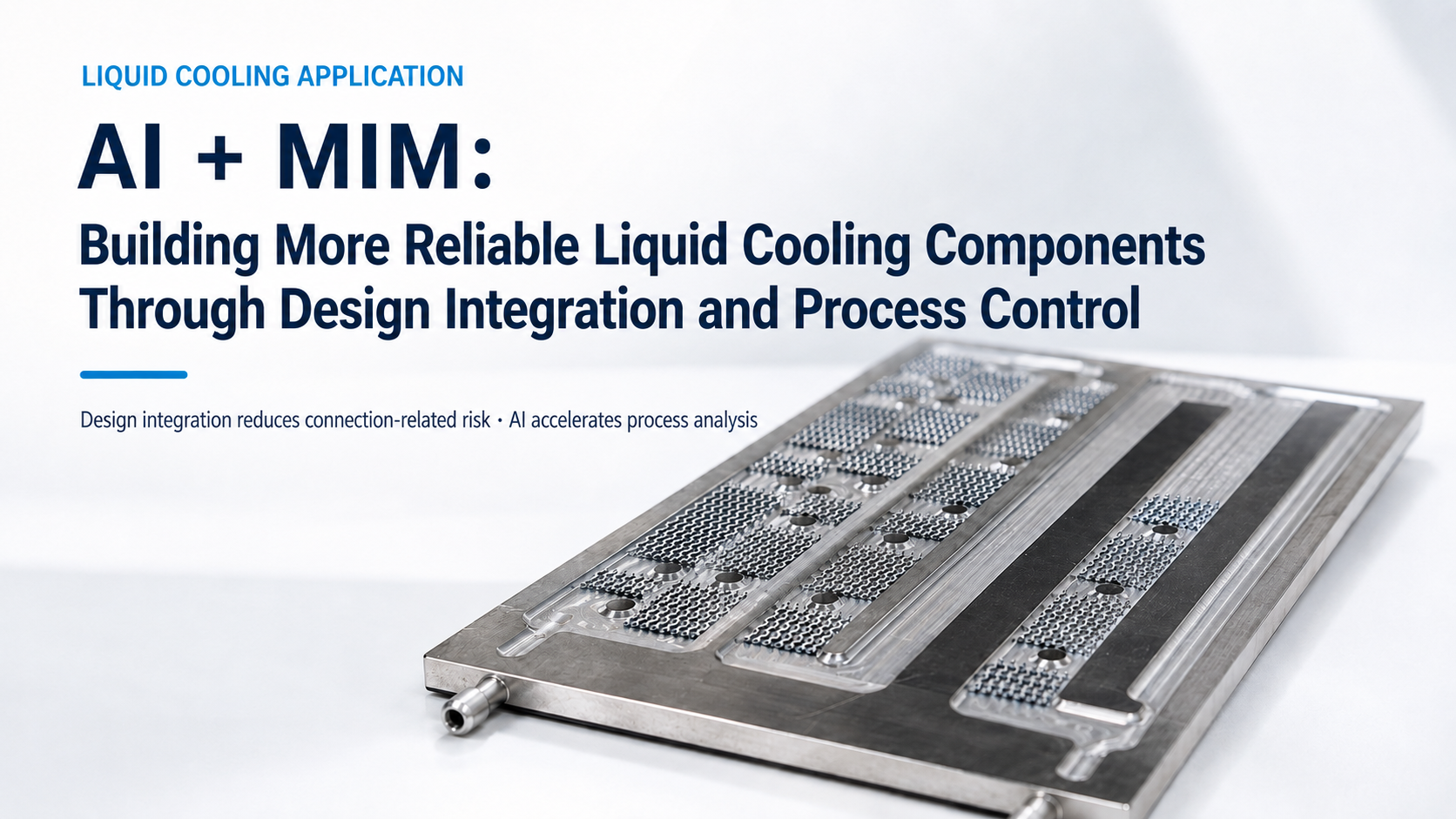
As AI servers and high-performance computing continue to advance, liquid cooling systems are taking on an increasingly important role in thermal management.
However, for liquid cooling components, reliability is not something that should only be considered during the final leakage test.
At Yibi Precision, we believe many risks begin to form when the component structure and manufacturing approach are first defined.
How Design Integration Changes Risk Management
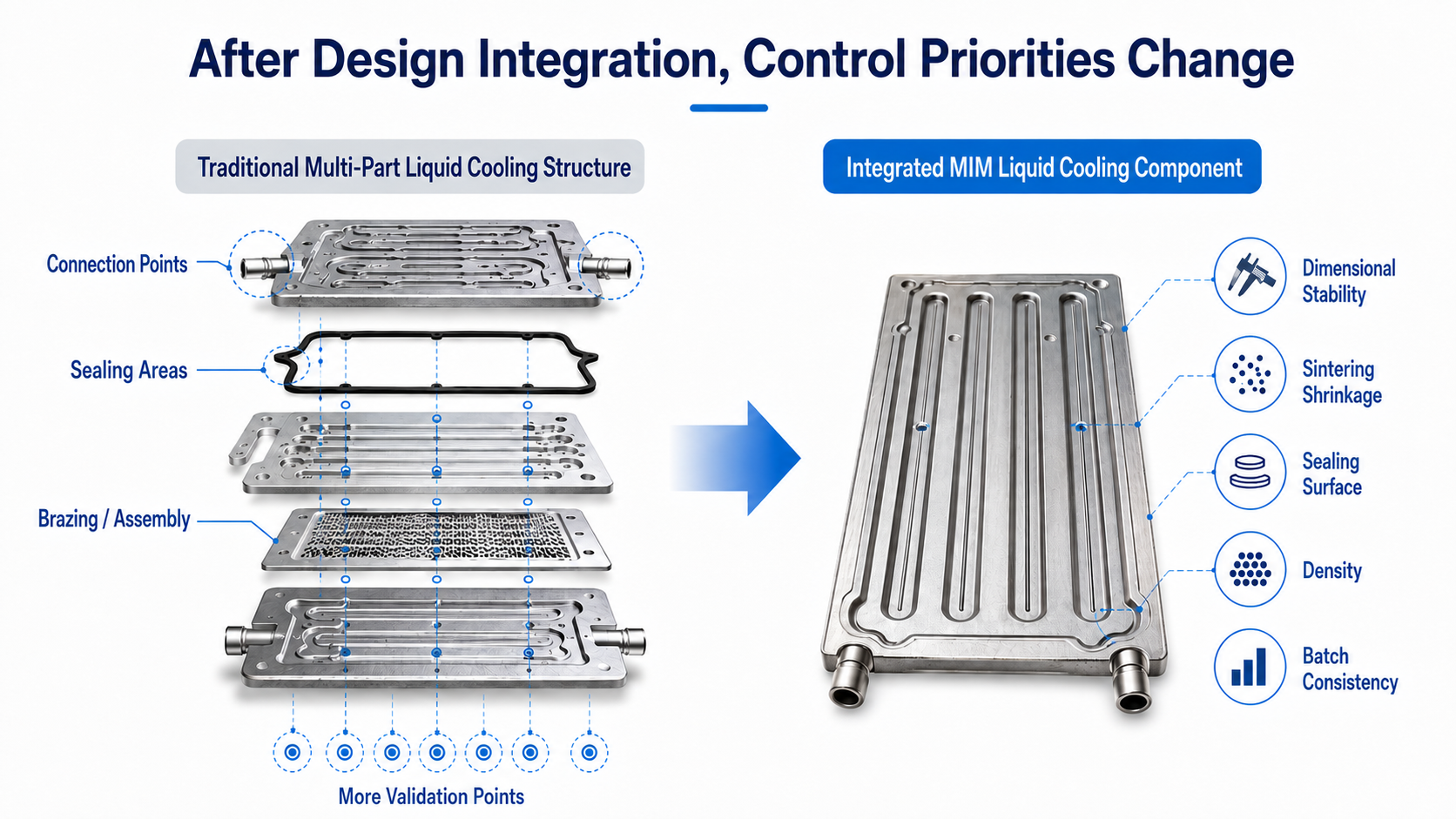
Traditional liquid cooling structures often include multiple metal components, interfaces, sealing areas, and connections formed through brazing or assembly.
Every additional connection introduces another point that requires dimensional control, assembly validation, and reliability verification.
Therefore, during the design stage, engineers should first ask:
Can the same function be achieved with fewer connections?
When the structure, size, material, and production volume are suitable for MIM, multiple complex features can be integrated into a single component, reducing certain assembly steps, brazed joints, and connection interfaces.
However, fewer connections do not mean that risk disappears.
When some connection and assembly steps are removed, engineers need to pay more attention to dimensional stability, sintering shrinkage, density, sealing surfaces, and batch-to-batch consistency.
This is why we view design integration as more than simply reducing part count.
Its value is not only fewer parts, but clearer risk control at the structural level.
After Integration, The Real Challenge Is Achieving Stable Mass Production
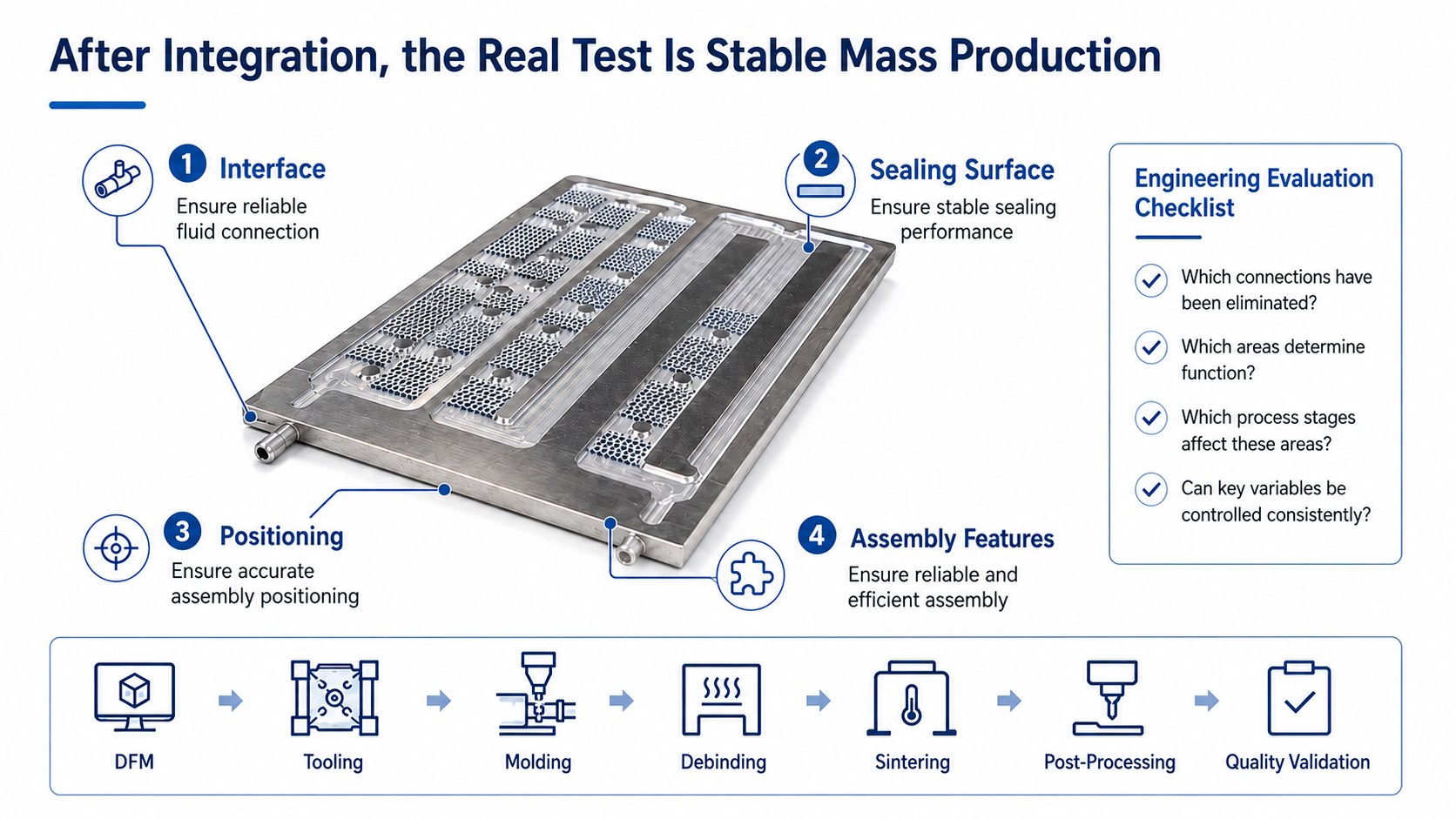
After integration, one component may simultaneously perform multiple functions, including positioning, connection, fluid interface, sealing, and assembly.
When evaluating an MIM liquid cooling component, the question is not only:
Can this structure be produced?
Engineers also need to evaluate:
1. Which connections and validation points are actually eliminated?
2. Which dimensions, sealing surfaces, or interfaces directly determine function?
3. Which MIM process variables can influence these critical features?
4. Can these key variables be continuously measured, traced, and controlled during mass production?
A successful prototype can demonstrate initial feasibility, but it does not fully answer questions about process capability and consistency under production conditions.
At Yibi Precision, we do not view MIM as an isolated forming process. From DFM review and tooling development to materials, injection molding, debinding, sintering, post-processing, and quality validation, every stage must work together around the final function of the component.
Only when process capability supports design integration can integration create real mass-production value.
Where Should AI Really Be Applied?
In complex manufacturing processes, a final abnormality may originate from multiple preceding stages.
When a liquid cooling component shows deviation in sealing surface dimensions, engineers need not only to detect the issue, but also determine whether the variation comes from injection molding, debinding, sintering, or post-processing.
AI can help compare process data changes, identify abnormal patterns, narrow the scope of investigation, and provide faster insights for root-cause investigation.
However, AI alone does not automatically create better manufacturing results.
The value of AI in manufacturing depends on whether the underlying process data is reliable enough.
Therefore, we view AI as an engineering decision-support tool:
Enabling data-driven decisions while keeping engineers responsible for understanding causes, risks, and final solutions.
For liquid cooling components, the real question is not simply whether MIM can reduce leakage.
The more important questions are:
Which risks are reduced through design integration?
Which risks still remain?
Which risks must continue to be controlled through the manufacturing process?
MIM helps reduce connection-related risks that can be addressed at the structural level. Process control determines whether integration can move reliably into mass production. AI further improves the efficiency of anomaly analysis and engineering judgment.
This is the core value Yibi Precision brings to complex metal component manufacturing:
Turning complex structures from design feasibility into validated, controlled, and scalable production solutions.