
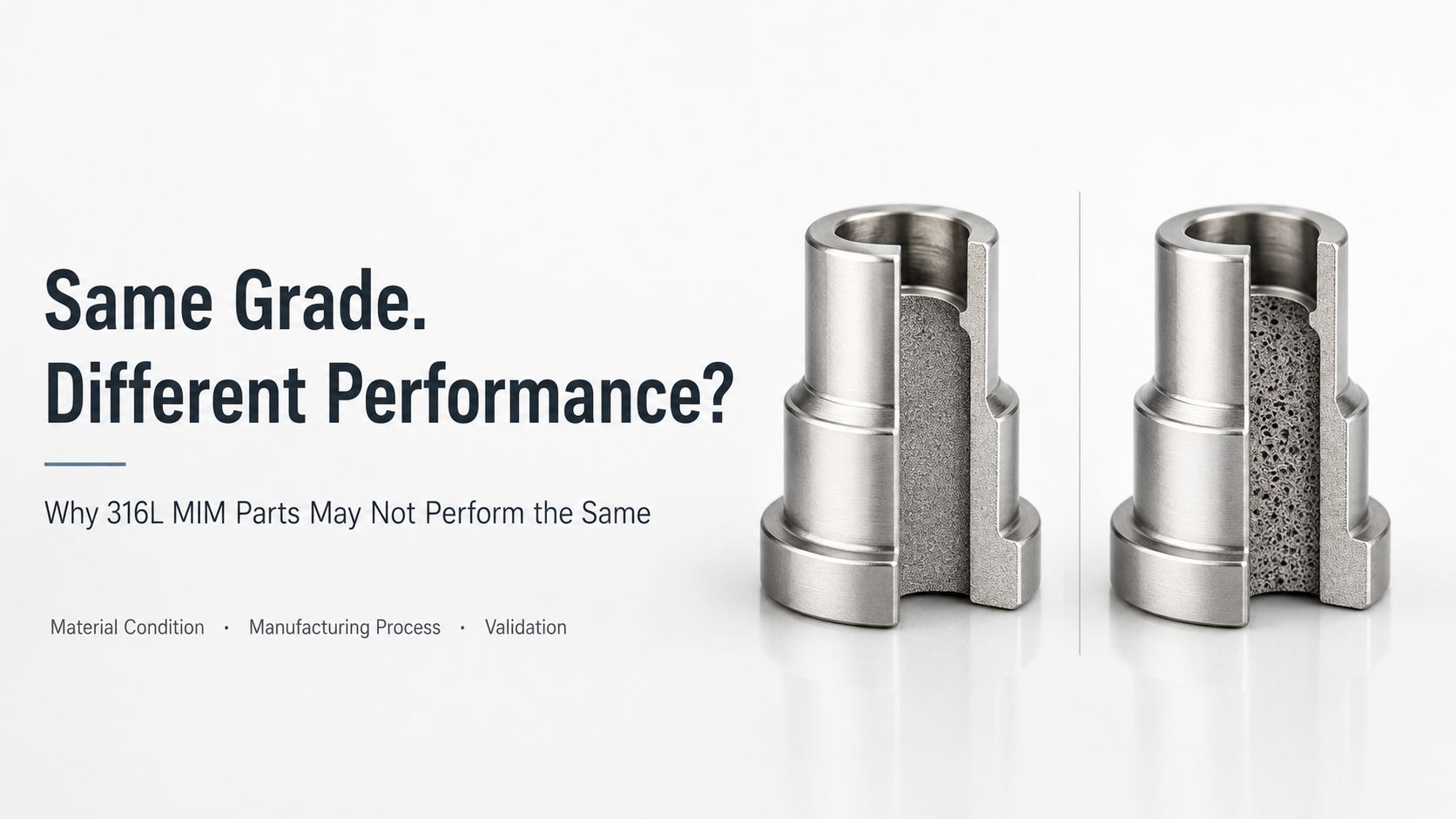
 Two MIM suppliers receive the same drawing.
Both specify 316L stainless steel. Both sets of samples meet the dimensional tolerances, and both chemical composition reports comply with the stated requirements.
At this stage, it is easy for a customer to assume that the two suppliers are producing the same part, leaving only price, capacity and lead time to compare.
However, once the parts enter actual service, they may still perform differently in terms of strength, elongation, corrosion resistance, wear resistance and cycle life.
The reason is that 316L defines an alloy system and a chemical composition range. It does not fully define the condition of the finished sintered component.
The Material Grade Is Only the Starting Point
The “316L” specified on a drawing first identifies the alloy to be used.
For a MIM component, however, final performance is also influenced by the metal powder, feedstock condition, molding process, debinding, sintering and subsequent operations.
When defining MIM materials, ISO 22068 and MPIF Standard 35-MIM address not only chemical composition, but also relevant mechanical and physical properties.
The material grade provides a common technical language, but it cannot by itself confirm whether the finished component will meet the requirements of the actual application.
Differences May Begin at the Raw Material Stage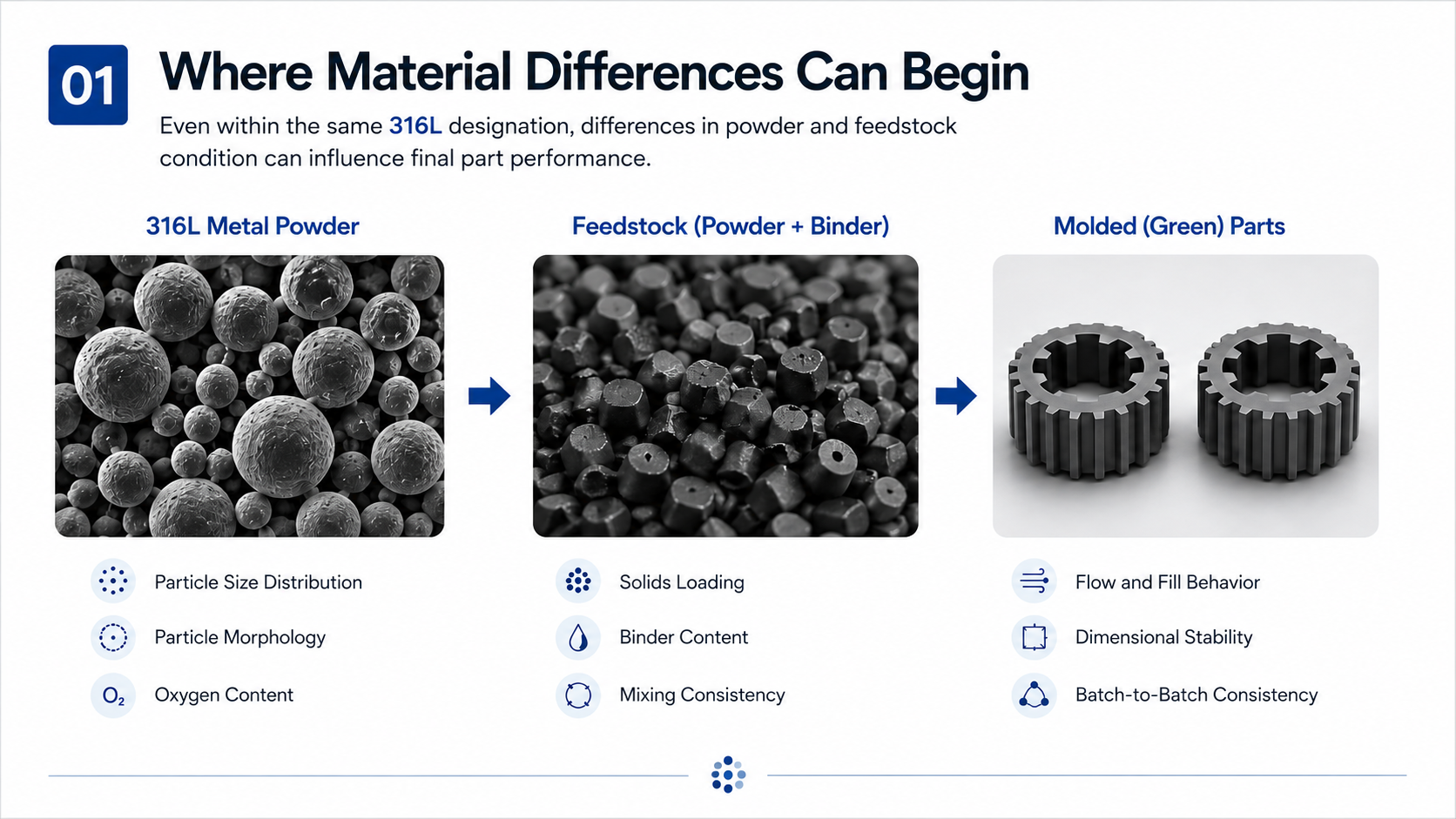
Even when two suppliers both use 316L feedstock, there may still be differences in powder particle size distribution, particle morphology, oxygen content, solids loading and mixing consistency.
These variables affect how the feedstock flows and fills the mold, and they can also influence the results of debinding and sintering.
The differences may ultimately be reflected in:
- sintered density
- pore size and distribution
- local shrinkage
- microstructure
- batch-to-batch consistency
These internal variations may not be visible during surface inspection, and they may not immediately appear in the dimensional results of the initial samples.
Sintering Is a Critical Stage in Establishing the Final Material Condition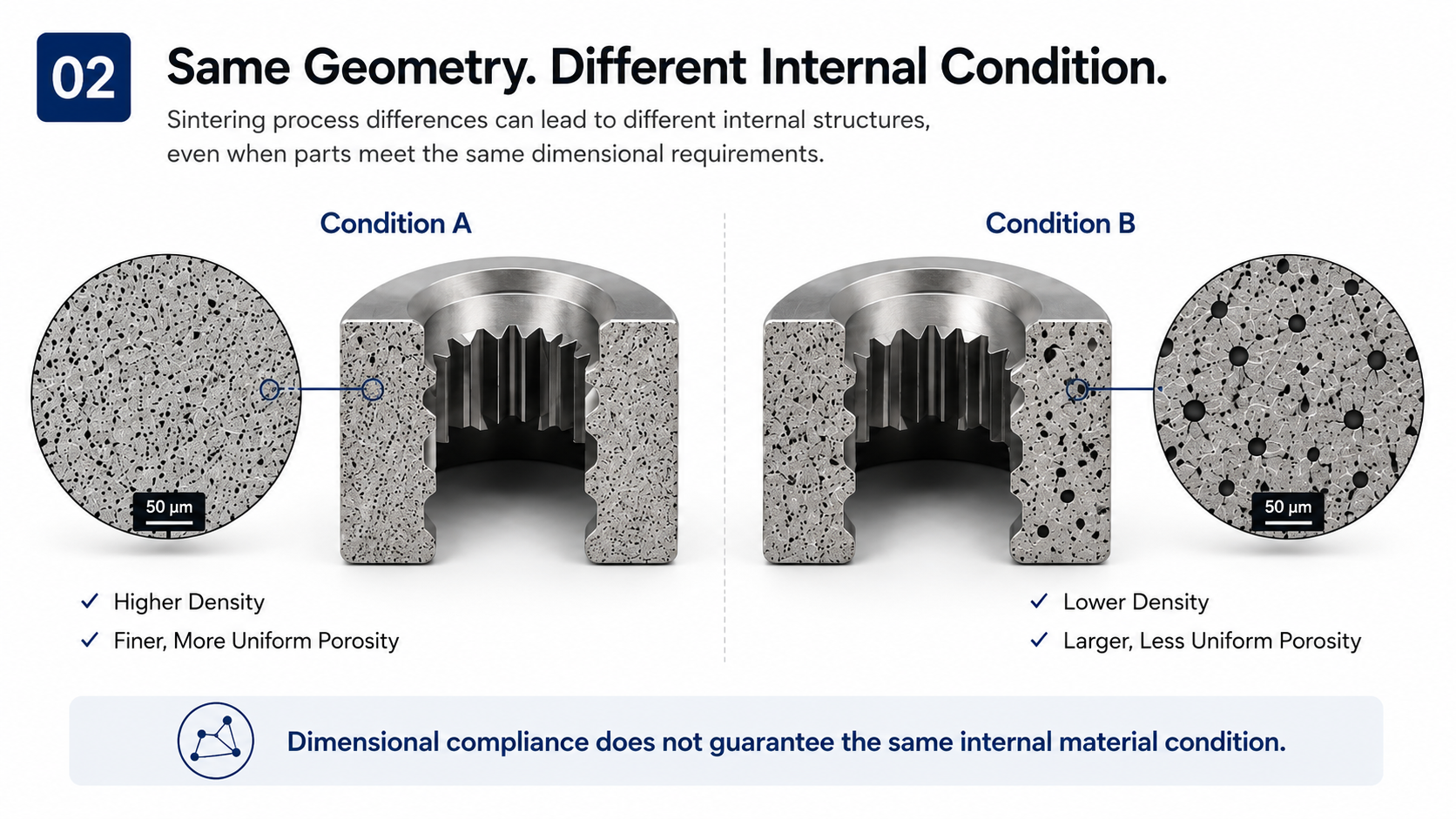
The final density, microstructure and major mechanical properties of a MIM component are largely established during sintering.
Sintering temperature, holding time, furnace atmosphere, loading arrangement and overall process stability all influence densification and microstructural development.
Even when two suppliers use the same feedstock grade, differences in their sintering processes may result in different levels of density, hardness, elongation and corrosion resistance.
This is why a dimensionally compliant component may still underperform in fatigue, wear, torque, corrosion or long-term cycle testing.
Dimensional inspection confirms whether the component meets its geometric requirements. It does not fully describe its material condition or long-term performance in service.
What Should Customers Actually Compare?
When evaluating different MIM suppliers, confirming the material grade is only the first step.
More importantly, clear performance requirements and validation methods should be established according to the actual function of the component.
Material Condition
In addition to chemical composition, the application may require confirmation of sintered density, hardness, microstructure or other critical material characteristics.
Mechanical Performance
Components exposed to load or repeated movement may require validation of tensile strength, yield strength, elongation, wear resistance or fatigue performance.
Service Environment
Whether the component must withstand corrosion, high or low temperatures, repeated impact, torque or long-term cycling should be defined at the beginning of the project.
Basis of Validation
The source of the test data—standard test bars, actual components or production batches—directly affects its relevance.
Standard test bars can demonstrate the baseline performance of a material system. Actual components, however, are also influenced by geometry, wall thickness, gate location and local sintering conditions.
For critical functional parts, relying solely on test-bar data is often not sufficient.
The Same Material Grade Does Not Mean the Same Part-Level Acceptance Requirements
MIM components made from 316L may be used in very different products and operating environments.
When the same material standard is applied, the basic chemical composition and specified mechanical and physical property requirements should remain consistent. At the finished-component level, however, the required acceptance criteria should be determined by the actual function and service environment.
Decorative components may place greater emphasis on surface condition, polishing consistency and corrosion resistance. Moving mechanical components may require additional validation of wear, torque and cycle life. Load-bearing components may require further testing of strength and fatigue performance.
What changes is not the 316L material standard, but the functional performance that each product must demonstrate.
When an application requires substantially higher wear resistance, hardness or strength, the engineering team should also reassess whether 316L remains the appropriate material.
Drawings, Material Reports and Performance Testing Answer Different Questions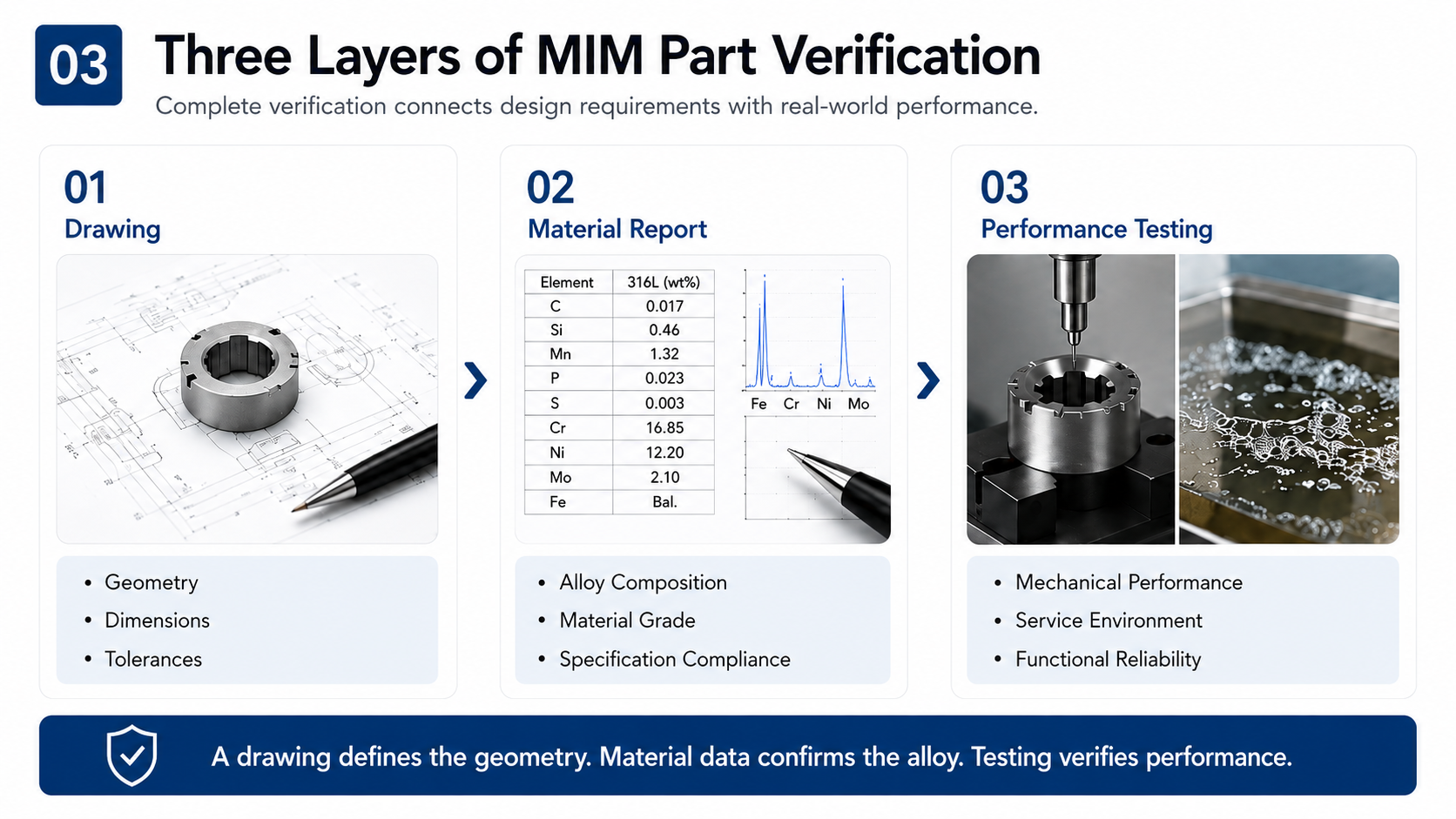
The drawing defines the required geometry and dimensions.
The material report confirms whether the alloy composition falls within the specified range.
Mechanical, physical and functional testing verifies whether the component can perform reliably under actual operating conditions.
Only when all three are clearly defined can MIM components from different suppliers be compared on a meaningful basis.
At YIBI Precision, material confirmation does not stop at the material grade or chemical composition report.
Our engineering team evaluates the actual function of the component, defines the required sintered condition, key performance indicators and validation methods, and translates these requirements into production controls and batch inspection.
For a MIM component, 316L identifies the alloy system, but it does not by itself prove finished-part performance.
What ultimately matters is the final material condition, the stability of the manufacturing process and the validation standards established around the actual application.