
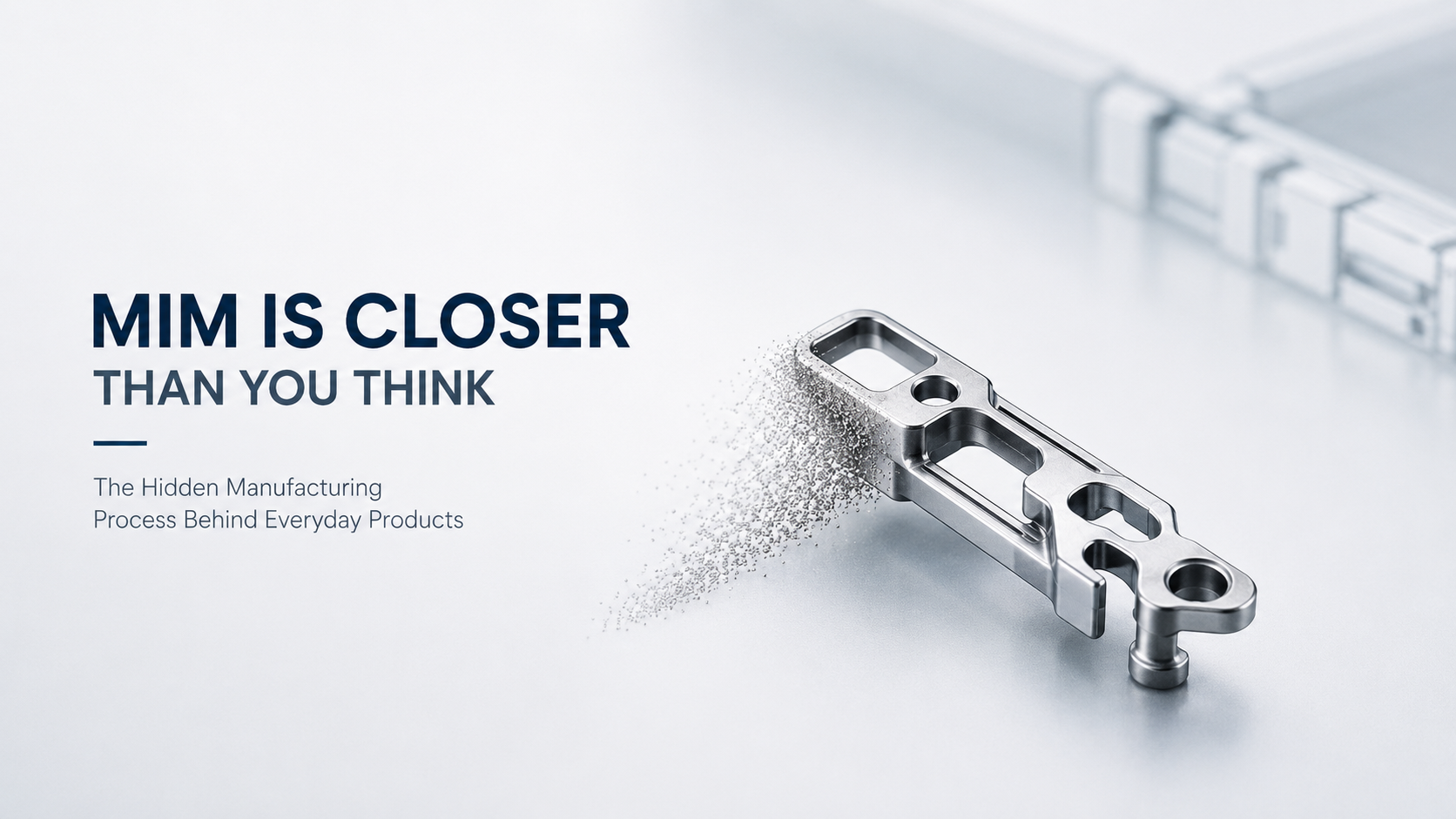
 A foldable smartphone may be opened and closed dozens of times every day.
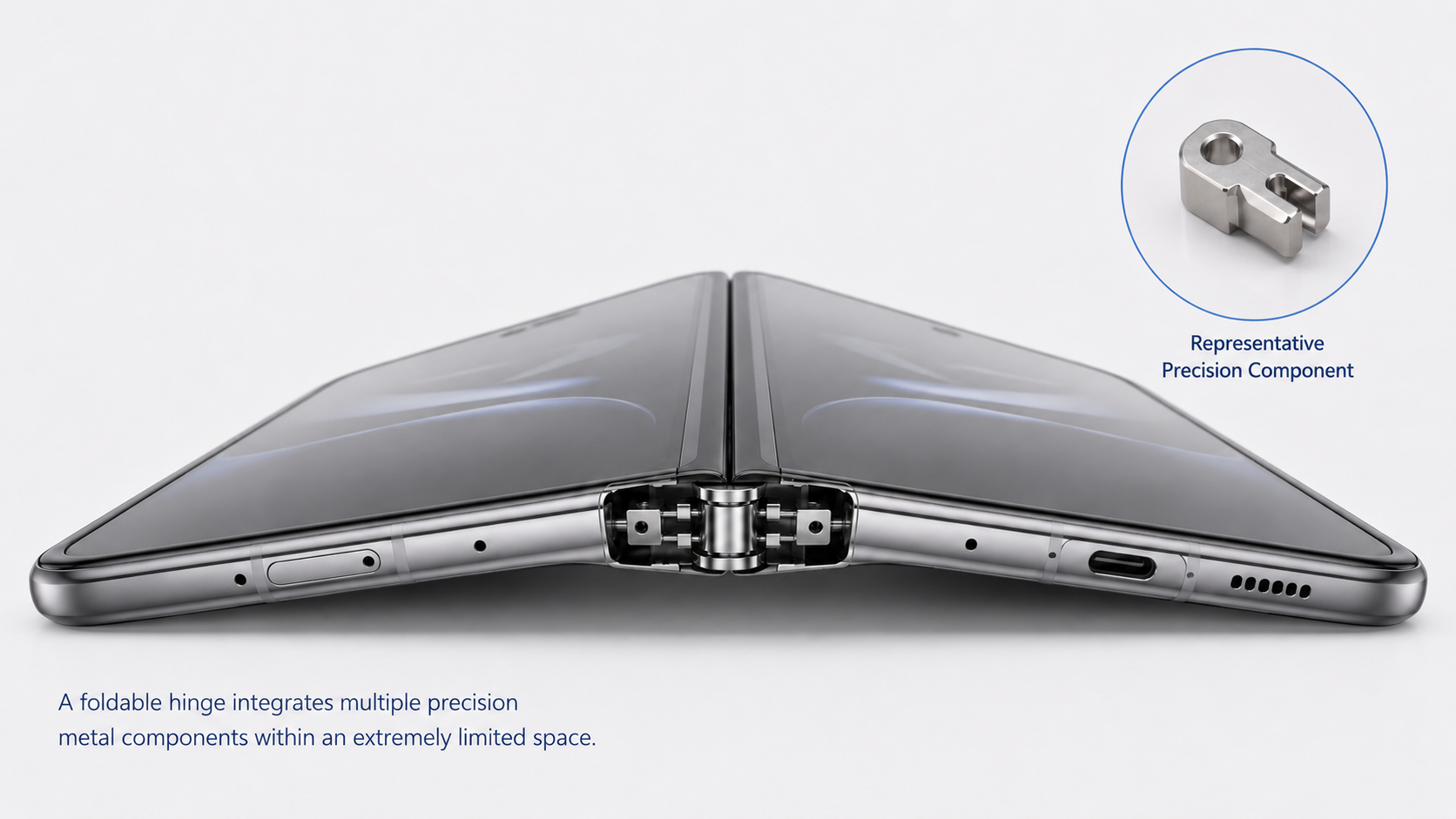
Hidden beneath the screen, its hinge must accommodate multiple precision metal components within an extremely limited space. These parts may be very small, yet they can contain holes, grooves, curved surfaces, locking features and complex connection structures, while still remaining stable through repeated movement.
When people see metal parts like these, they often assume they were produced by CNC machining, stamping or casting.
Some of them, however, may come from a manufacturing process that is still unfamiliar to many consumers, despite being widely used across modern industries: MIM.
MIM stands for Metal Injection Molding.
Simply put, it allows metal powder to be injected into a mould in a way that is similar to plastic injection moulding.
 How Can Metal Be Injection Moulded?
Plastic injection moulding is already familiar to most people.
Plastic is heated until it becomes flowable, injected into a mould and then cooled into its final shape. MIM follows a similar forming principle, but replaces plastic with metal powder.
During production, fine metal powder is first mixed with a binder to create a flowable material known as feedstock.
The feedstock is heated and injected into a mould cavity, where it forms the initial shape of the component.
At this stage, the part is known as a “green part”.
It already has its complete geometry, but it has not yet reached the density, strength or functional performance required of the final component. It must then pass through two critical stages: debinding and sintering.
Debinding removes the binder from the material.
Sintering then exposes the component to high temperatures, allowing the metal particles to bond and become denser. This process transforms the green part into a functional metal component.
An Interesting Fact: MIM Parts Become Smaller
MIM differs from conventional plastic injection moulding in one particularly interesting way.
A newly moulded MIM part is not yet at its final size.
During debinding and sintering, the removal of the binder and the densification of the metal particles cause the component to shrink according to a calculated ratio.
This means the mould cavity must be larger than the final part.
Manufacturers need to account for this shrinkage from the mould design stage.
Whether the component shrinks as expected, whether thin walls or complex surfaces become distorted, and whether critical dimensions remain stable all depend on the control of materials, tooling, injection, debinding and sintering.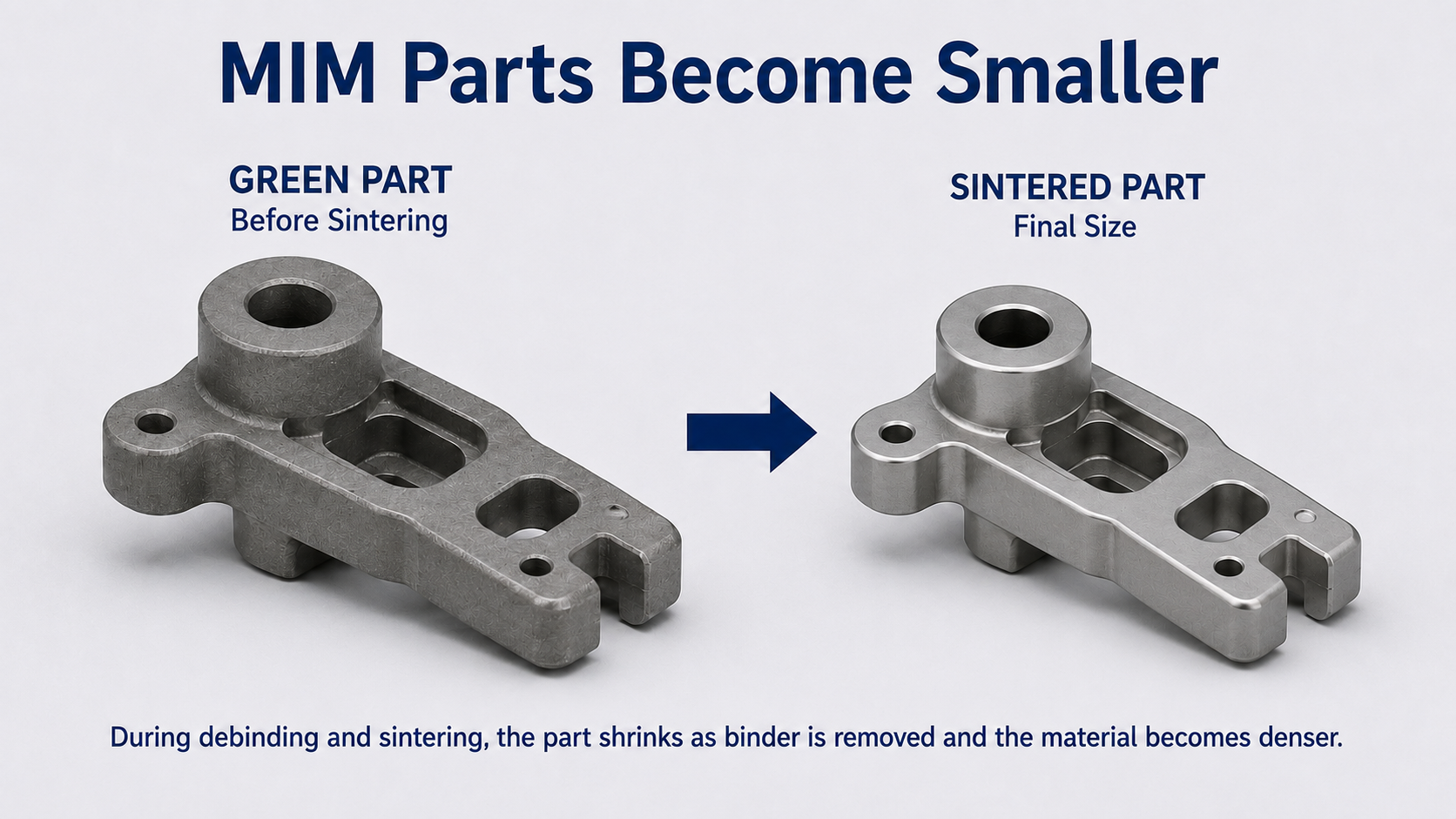
Why Do Modern Products Increasingly Rely on MIM?
Products are becoming smaller, lighter and more complex.
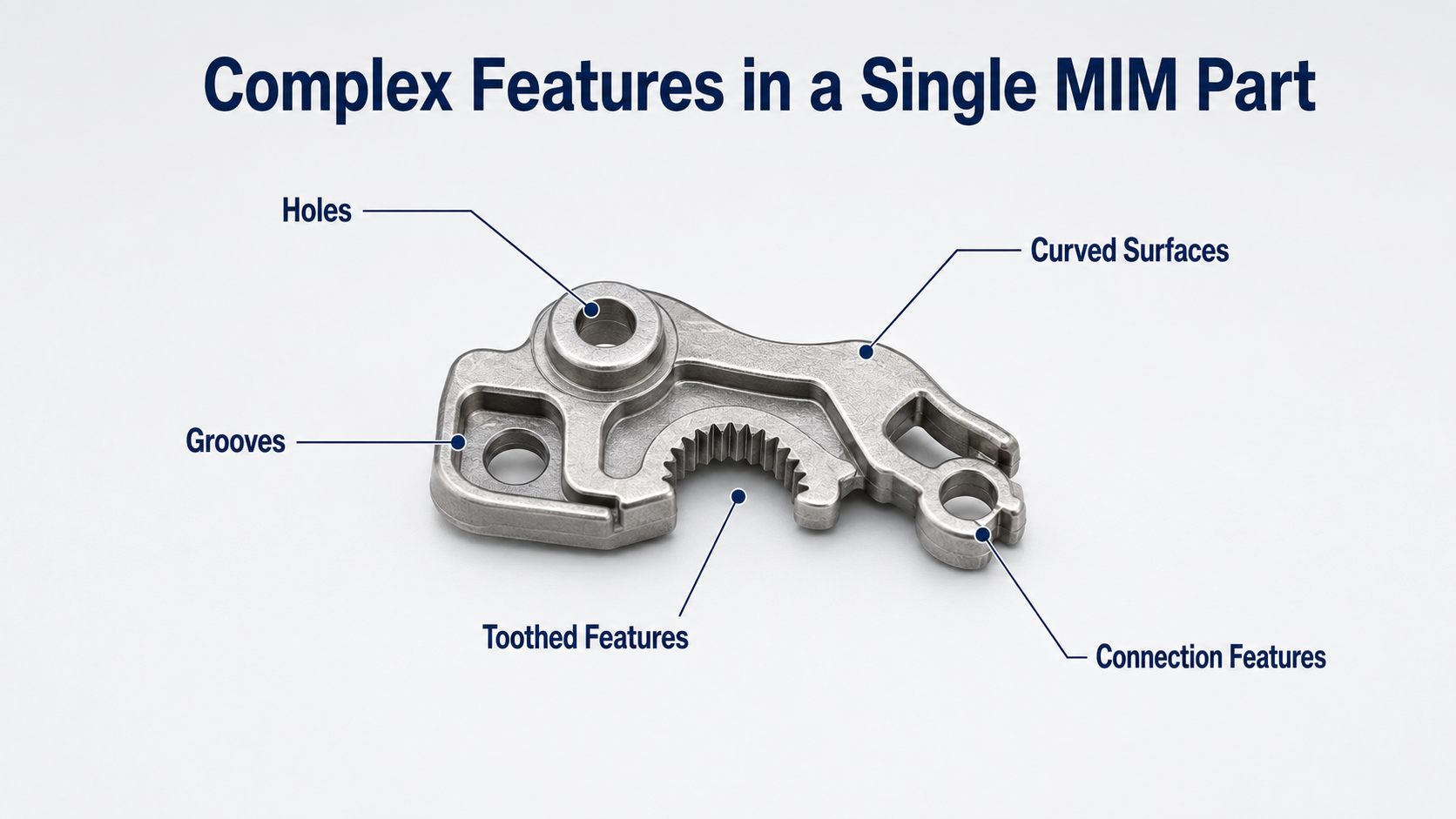
A metal component that appears simple at first glance may contain:
- Holes and grooves
- Curved surfaces and thin walls
- Teeth and locking features
- Irregular geometries
- Lettering or identification marks
- Multiple functional connection areas
If these structures were produced entirely through conventional machining, they could require multiple setups, several machining operations and, in some cases, the separate production and assembly of multiple parts.
MIM can form more complex features directly within the mould.
Shapes that would otherwise require several machining operations may be produced during the forming stage. Structures previously assembled from several components may also be redesigned as a single integrated part.
This gives product development teams greater freedom in structural design.
The value of MIM is not limited to production efficiency. It can also reduce secondary machining, simplify assembly and provide a more stable manufacturing route for medium- to high-volume production.
The Challenge of MIM Goes Far Beyond Injecting Metal into a Mould
At first glance, MIM may appear to be little more than the application of plastic injection moulding principles to metal.
In practice, every stage of the process can influence the final result.
The particle size and composition of the metal powder affect flow behaviour and sintering performance.
The mould structure, gate position and cavity design affect material filling and the density of the green part.
Injection temperature, pressure and speed influence the internal uniformity of the component.
The debinding stage must be carefully controlled to prevent cracking or deformation.
During sintering, temperature, atmosphere, part positioning and shrinkage control directly affect the final dimensions, density and performance.
Even when two parts appear identical, differences in material control and process management can lead to very different results in use.
The real capability behind MIM therefore lies in the coordination of materials, tooling, injection moulding, debinding, sintering, secondary processing and quality control.
A Manufacturing Technology Hidden Inside Everyday Products
MIM rarely becomes a headline feature in product marketing, yet it may determine whether a complex structure can be made smaller, lighter and suitable for stable mass production.
Consumers see a phone that folds smoothly, a lock that operates reliably or a tool that continues to perform. Behind these functions are often precision metal components that remain largely unnoticed.
MIM may be much closer to everyday life than most people realise.
You may be using MIM parts every day without ever hearing the name of the technology behind them.